You can change the style the forum displays by selecting your preferred style at the bottom left of the site.
We have made an enhancement so that old threads should now link from search results to the correct thread. This is not yet in place for single post links
Random stuff you find browsing the internet, I know 2 intercoolers has been discussed a couple of times on here. Mark at Automark sometimes advocates twin intercoolers and DJones uses them rather effectively.
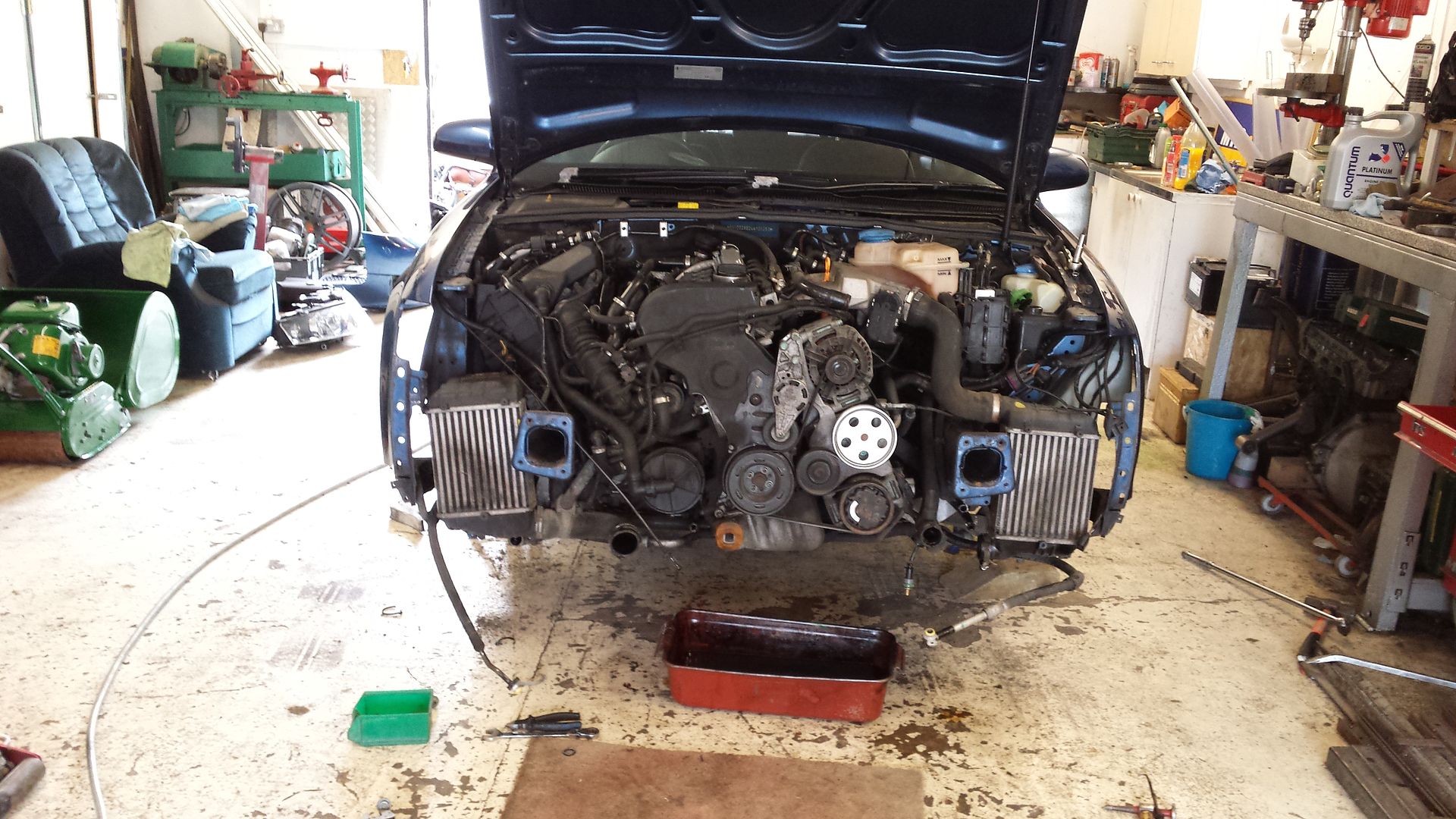
Audi A4 B6 1.8t 190 has twin intercoolers in series, upgraded from a single in the lower power 1.8t.
Intercooler efficiency is largely a function of airflow, surface area and volume. Dual side mount intercoolers seem to be best used in applications with space constraints.
My guess is Audi would have went with one FMIC vs. the DSMIC pictured above (also used in the TT225) if they could have fit the packaging better as there would have been more surface area and less piping/clamps involved.
All about space, on the B4 there is very little, as they had the dual intercooler setup in the same chassis range with the higher powered 2.7tt they just adapted it.
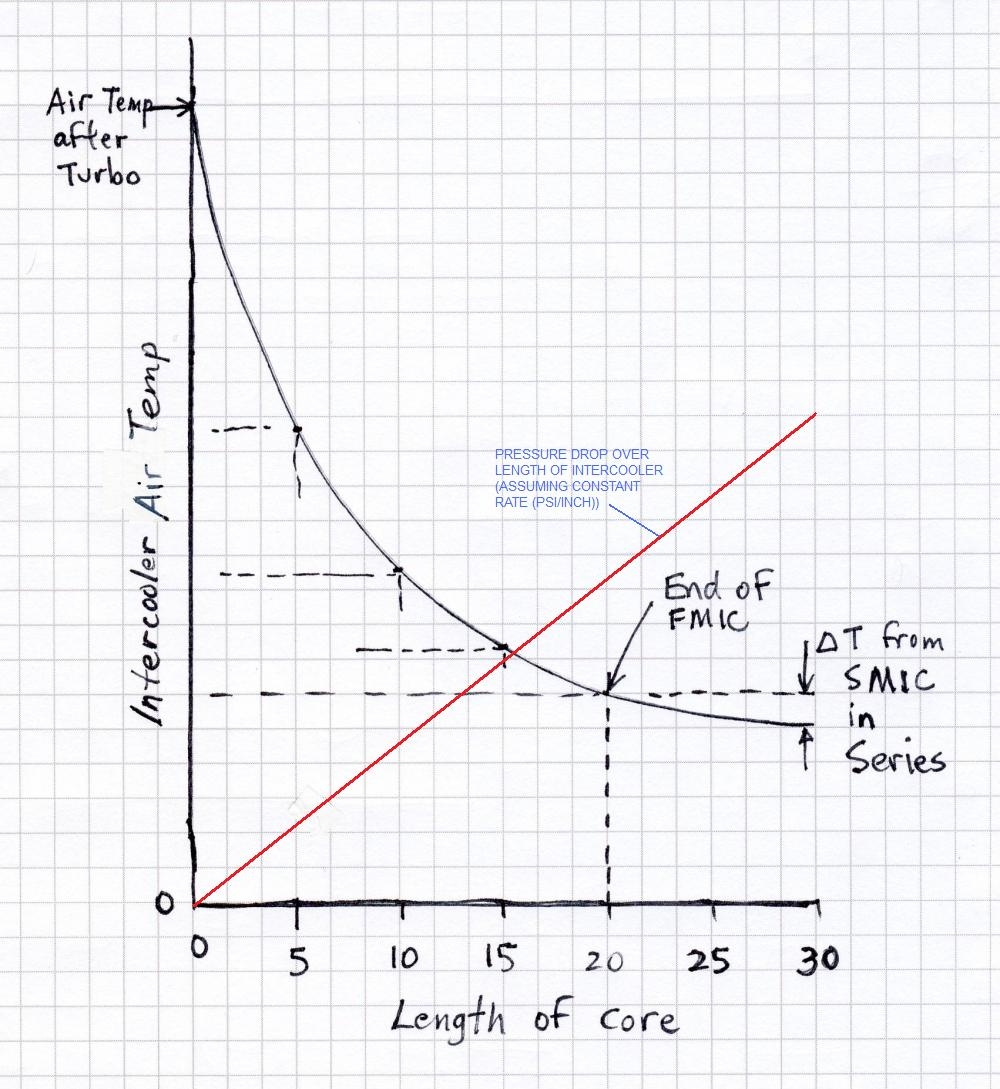
You'd get additive pressure loss for marginal decrease in air temps. Basic physics/thermodynamics. This example was for FMIC and SMIC in series but it would be similar for SMIC and SMIC in series. The first SMIC would do the bulk of the temp drop the second very little temp drop but 100% of the pressure loss of the first SMIC.
RS2'd 93 UrS4 5 spd sedan
94 UrS4 V8 6 spd manual avant
It's all relative and dependent on the size and efficiency of the cores.
Two high quality cores in series can be far more efficient in cooling with less pressure drop than one single cooler with equivalent combined volume but with an inefficient core. Just look at how bulky and inefficient cheap ebay coolers can be.
Pressure delta is also less important than the requirement to control IAT adequately
Panthero Coupé quattro 20vt
Indigo ABY coupé
Imola B6 S4 Avant
It is a compromise, most car parts are, I just thought it was interesting that Audi considered the second worthwhile fitting when they upped the power.
Dave I think the idea of the graph is correct, but when you are working with small intercoolers (due to packaging constraints) your intercooler end intersects are incorrect.
You show a 17 unit drop from 23, 73% from the first intercooler, but only a single unit drop from the second intercooler, 4%, whereas Djones was getting a 20% temp drop from the second intercooler, which is significant.
I think a better representation when using 2 smaller intercoolers would be a temp drop of 13 units, 56% for the first intercooler, then a temp drop of 4 units, 20% for the second intercooler on your graph? Still represents the diminishing returns but shows why it could worthwhile fitting a second intercooler if the first intercooler is small?
The intercoolers pictured are very short in comparison to most front mount intercoolers.
Interesting topic, for me it was also about maximising air speed. You would very quickly feel a draught in a small room than you would in a hall and so does the engine when it comes to flow.
After a 2 bar pull my inlet manifold is cold to the touch. If I allow it to heat soak whilest standing still and reach the same temp as the rest of the engines and then go for a run it's cold again, so the ability to remove heat is fine and it virtually has no lag even with 8:5cr and a .82 hot side so air speed is working too. It can't be restrictive as it's produced nearly 500bhp on a slightly cleaned up RS2 exhaust manifold. Not hugely scientific but ticks all of my requirements.
Agreed, nothing like real world results rather than just theory. It appears keeping air velocity high post compressor is key to a responsive motor. I know in the numerous chats I've had with Mark (Automark) regarding this subject it's something he's swore by.
Its another trade off. Smaller diameter pipes give higher velocity but are more restrictive top end. A higher volume intercooler core will also slow the air down but the air will therefore be in it for longer and cool more.
We process personal data about users of our site, through the use of cookies and other technologies, to deliver our services, personalize advertising, and to analyze site activity. We may share certain information about our users with our advertising and analytics partners. For additional details, refer to our Privacy Policy.
By clicking "I AGREE" below, you agree to our Privacy Policy and our personal data processing and cookie practices as described therein. You also acknowledge that this forum may be hosted outside your country and you consent to the collection, storage, and processing of your data in the country where this forum is hosted.





Comment