

Ok, pls back up this cold air expanding spoolup theory with some article or writeup from an authority. Thanks.
-
Everything less than 2 bar is considered to be naturally aspirated -
I can't publish confidential papers based on FEV test results. All i can say is that it came from the development process of the new BMW IL6 engine (N55). http://www.bmwblog.com/2010/01/02/tw...ign-explained/
Perhaps some papers are available through SAE, i don't know.
The expanding air theory is very old and is commonly used on turbojet engines.
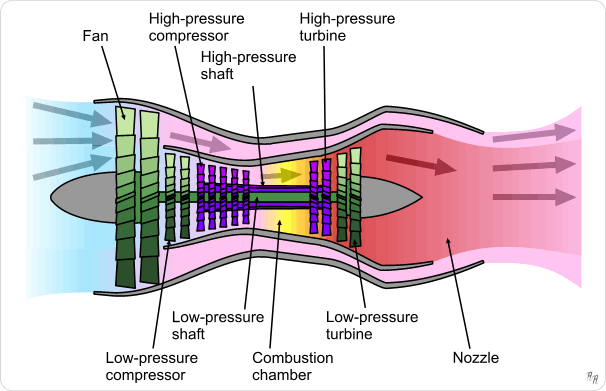
Most modern jet engines are actually turbofans, where the low pressure compressor acts as a fan, supplying supercharged air not only to the engine core, but to a bypass duct. The bypass airflow either passes to a separate 'cold nozzle' or mixes with low pressure turbine exhaust gases, before expanding through a 'mixed flow nozzle'.
http://www.ueet.nasa.gov/StudentSite/engines.html
Back to cam timing for the IL5's. What amount of overlap do people run with what A/r turbine?Comment
-
Repo, next step for you!
Audi 5cyl 20V V-tec
One thing i've learned we are way behind the Scandinavians!Comment
-
Billman asked 'is this crucial on a turbo engine' , not my so i was talking about it in general.
Some kind of Porsche Vario Cam could made possible.

Audi has it's own VTEC these days on the FSI engines.

Comment
-
1.8T engines use similar intake cam timing system as porsche, but I think it's being used mostly for emissions.
2.7T engines use it for performance.
If You mean Vtec like in Hondas, no way, if You ment Vtec as a synonyme for adjustable cam timing, yea, a variocam type of setup might be possible to construct.
I am quite sure the benefit got at low rpm, by advancing the intake cam in 2.7T does not come from enhancing the spoolup, but reducing the backdraft immediately after BTDC, and therefore making the engine itself do better.Everything less than 2 bar is considered to be naturally aspiratedComment
-
Repo you are allright!
2.7t got a variable inlet cam timing for better torque at low rpm...
...in power setting (high rpm) the inlet cam timing is set to "late" and in tourque setting (low rpm) the inlet cam timing is set to "early"...
...responsible for this behaviour is the point of inlet close - there is an adjustable angle of 22deg...
4.2 in RS4 B7 has variable cam timing on inlet and exhaust cams... ist is used for power and torque setting like 2.7t AND additional for reducing emissions at low rpm by forcing inner backflow of exhaust gas by valve overlap...
PS the new TTRS R5T uses the same technology on inlet and outlet...
...and only with direct injection you can use a wide angle of variable cam timing (TTRS 42deg on inlet and exhaust cam)...Comment
-
PS I think you misunderstood the turbofan:
Turbofan engine
In turbofan engines only a small part of the thrust is generated in the core engine, i.e. compressor, combustion chamber and turbine. The major part is produced by the bypass flow through the fan and the low-pressure turbine. The fan feeds large air volumes downstream which surround the engine like an envelope and thus reduce the engine noise. With increasing bypass ratio, i.e. ratio between internal and external airflow, operating cost, emissions and noise are reduced. Bypass ratios of turbofans for modern airliners are now about 6:1, i.e. the bypass flow through the fan and around the engine is six times the airflow through the core engine.
source: MTU Aero EnginesComment
-
So then scales tend to be used stock cams instead 7A? I'm asking because I have plan to use such in my new project around 450hp. It will be stock Head. Any recommendation on this subject ?Comment
-
Definately stock cams for 450hp.Everything less than 2 bar is considered to be naturally aspiratedComment
-
Any recommendation on 550 PS ??
Comment
-
I don't understand what application your referring to on a modern turbofan. If you are suggesting that the expanding hot exhaust stream is somehow pulling the cold stream through some sort of scavanging effect then you are wrong. "Jet" thrust is a result of mass flow. The main function of a mixer nozzle is to reduce noise output caused by the shear layer between the very high velocity core exhaust, and the relativly slow moving bypass stream. A byproduct of this is a slight increase in thrust, for the same reason, having one large stream moving at simillar speeds, rather than a dougnut of low speed air and a thin stream of very high speed air.
Regards cam timing, I know very little so Ill keep quiet, I was just interested in your jump fro mcam timing to jet engines.
-Kieron.1994 URS4 Avant RS2+Comment
-
Yea, stock ones.Any recommendation on 550 PSEverything less than 2 bar is considered to be naturally aspiratedComment
-
In theory, using the 7A exhaust cam alone improves mid and top end performance for a slight loss of torque at 2000rpm. depends what you are after..1986 Coupe q - 2281cc 3B, chargecooler, 2.75" exh & downpipe, ported head, water injection, CGR box, modified MD357 turbo, 440cc injectors, high power coil.
2004 A4 2.5TDi convertible, re-mapped to 180bhp
2011 A5 sportback 3TDi-Backbox delete, remapComment


Comment