Breather Systems for people who don't know

Collapse
X
 
  • Time
  • Show
Clear All
new posts

  • Rusty
    replied
    This has indeed been covered in various threads over the years but I agree that there is a lot of information that is confusing to newcomers to the system.

    The things that overwhelms the OE system are a combination of the amount of oil that runs down from the head breather under acceleration (that has to find its way back to the sump via the rather smal diameter T piece), full load acceleration of say 0.3g and higher and turning right at high load. On their own, each of these things adds a little oil to the system, which can be dealt with, but under a combination of these circiumstances, not only does the engine have the most blow-by but it also has enough acceleration to cause oil to run down the head breather and the oil in the sump starts to interact with the crank case breather: this is too much for the system to cope with.

    Real world data:-
    • On the road with ~300bhp and plenty of 1st-2nd gear thrashes - no additional oil in the catch tank.
    • Counter clockwise track - mainly left turns and plenty of 2nd gear corner exits (higher accelerating g) - virtually no additional oil in the catch tank.
    • Clockwise track, mainly 3rd gear corners (Castle Combe) - 150-200ml oil / 10 lap session into the tank.
    • Just the head breather outlet, 1st & 2nd gear runs - 100ml in 10 runs into a separate tank (this would normally go into the T piece over the crank case breather).

    An oil separator or swirl pot would be a great improvement on a road car with RS2 power levels; add a sump return for higher power levels or track use. For more than RS2 power, you really want to add a catch tank in there, as a second line of defence, and also replace the head breather with something better situated and of better bore.

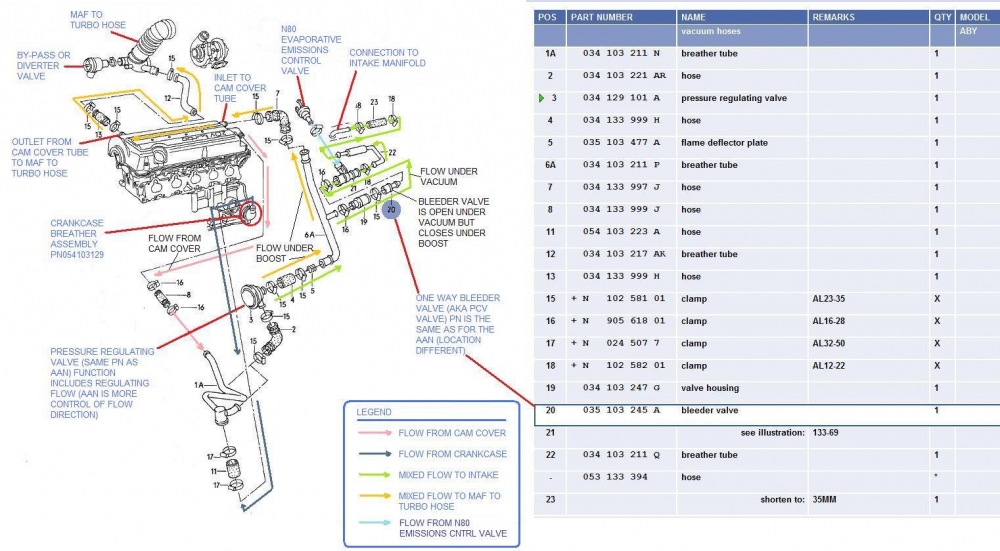
    In terms of the OE operation, the PCV valve is generally shot, the flame trap blocked and the 1-way valve tempremental. While the system would have coped well with the OE S2's power, it's now too old to do so. Replacing all of these is a must, if you need to keep them on the car.

    Having run my car without the PCV valve and the N80 connected straight to the head for 2 years, I can detect no adverse running whatsoever. Should someone wish to replace the PCV valve, 1-way valve and retain the OE style N80 system, this can all be worked into a replacement system with ease - merely add the swirl pot (which combines the head and crank breathers) before the PCV valve and add a 14mm nipple to any catch tank or return pipe setup to take the 1 way valve and N80 T piece.

    If anyone has any specific questions or requests, I'm always happy to answer them and share what knowledge I have of the breather system

    Leave a comment:


  • Sonic
    replied
    The solution i'm fitting is a top-breather on the cam-cover (which i appreciate is far from OEM) running to a swirl-pot, the rear cam-cover breather running to the crankcase junction box, the crankcase breather to the swirl-pot, and then a bottom vent from the swirl-pot to the sump return, and a top vent to a catch-tank, and then catch tank to the MAF hose... just as JP drew a diagram for a while ago.

    Leave a comment:


  • Ross
    replied
    I think there's a great selection of diagrams and explanations linked here already, I'll certainly have this thread open on the laptop when I put the breather system back in tonight!

    I'm really with David on this one - I want a simple solution that ideally fits into the stock system but addresses the main issues Seems like it would work OK on cruise when under 'partial vacuum' (now that's a phrase that makes no sense - 'intake pressure is lower than ambient') but uner load there's oil going everywhere so my ideal solution would be something that retains the stock set-up with a separator and return to sump + fumoto valve. I could live with that.
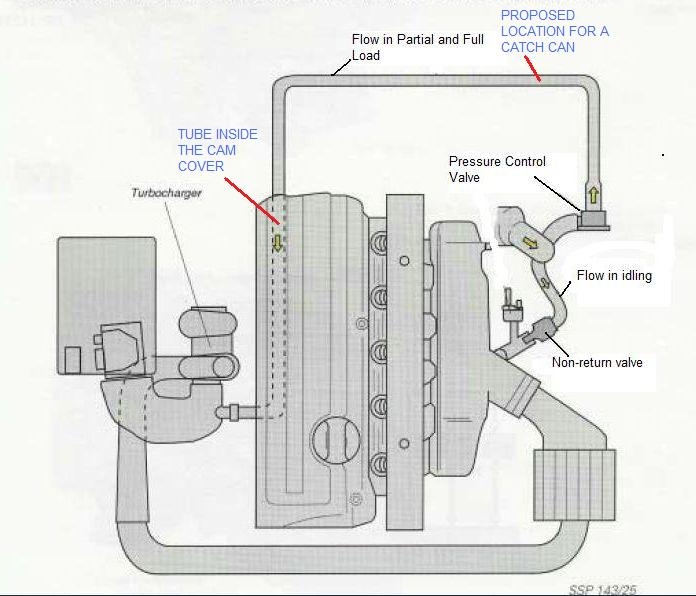
    I'm leaning toward a revised version of UrS4's non-ideal soution of a separator on the intake line. Based on Vas' experience, it looks like a decent separator is required, hoses should be replaced with bigger bore, and it should drain to sump. Otherwise it's pretty much a waste of time.

    Leave a comment:


  • A80Avant
    replied
    Originally posted by UrS4boy
    I would suggest a catch can, perhaps like that offered by 034, located as shown schematically here:


    That is excactly what i had but the saiku michi tank i had(which supposedly is one that the japs use a lot) did NOT work adequately on that position and could not separate the blow by from the fumes,hence a lot was going back in the turbo inlet anyway.

    I think the first thing is to remove any restrictions. Unfortunately the PCV valve although it plays a role in vaccum conditions and cruise, it is a restrictor in the system, maybe one to allow less blowby to come towards the inlet of the turbo. After that you then have the flame deflector, another little ****** that gets glogged up and can produce an enhanced restriction.

    Finally as mentioned above, the camcover is draining to the same area the PCV valve is through a tiny 13mm tube, and it looks that in a healthy motor, the amount of oil draining back down from there is immence. So the way i see it is, that during boost the oil from the camcover has to travel down to the block and then any blowby has to go through the PCV valve and upstream to the inlet of the turbo through the metal tube that passes through the cam cover. Looks almost similar to all the tubing used to get air from the turbo through the intercooler and into the manifold going in circles in this engine!!! geez!

    By sticking a tank in the upstream tube is not a perfect solution, it could be an adequate one on stock boost etc to reduce the amount of oil going to the turbo and making it look awful,while at the same time getting all the inlet tract dirty.

    If you remove the restrictions (pcv valve, and flame deflector), then more blowby is coming up, therefore you need a more comprehensive system to cope, ie JPs 2 tank solution)

    I tend to think that there are 2 things to deal with here:

    1) the blowby that will get the inlet tract dirty
    2) the pressure build up that will wear and tear the engine bits

    1---> can be dealt with a simple tank but its not going to improve the wear issue, while it actually may make it a bit worse, esp if you think that the tank may actually add a small restriction itself if not built right

    2----> to reduce that you need large tubing good routing so that oil is not wasted, and engine is running freely.


    All this is my view of the system after having tried 3 different tanks, and a few configurations. I also added a check valve to the return line, and some people weld deflectors on the oil pan to reduce the incidence of oil having a reverse flow towars the tank when on boost. A check valve will cure that (thanks Jade!),

    Leave a comment:


  • UrS4boy
    replied
    Potential Location for a Catch Can

    I would suggest a catch can, perhaps like that offered by 034, located as shown schematically here:

    Leave a comment:


  • macspring
    replied
    Thanks Dave,

    if I read slowly and concetrate and stare a lot, it starts to go in.

    All - That's how it works oem style, what's the non oem tried and tested solution ?

    Similar to 996 calipers and 323 mm front brake discs, a homefry chip, recaros, s8s, Neuspeed ARB for Avants, HIDs for ellipsoids, wagner kit, aero wipers, RS2 kit for an ABY engine, dash boost gauge.

    Thanks again.

    Leave a comment:


  • Thuppu
    replied
    Would say the stock breathing system is too restrictive for high hp applications. Mine was leaking oil everywhere with only 380hp. Like you see in the pic, there is a million potential leaking points. Also the head breather in the back of the head is brainfart. In cold winter climates there is also a big risk that the breather freezes. Happend a lot with the 1.8T and the ice in the breather hoses easily destroys the turbo.

    Leave a comment:


  • UrS4boy
    replied
    Originally posted by Bowlerwell
    Interesting.
    It would be good to have a comprehensive description of the breather system, and what maintainance could/should be carried out on it.
    You might want to have a look at Post 3 in this thread (link under diagram):


    Post 3 of this:

    Leave a comment:


  • A80Avant
    replied
    i think Rusty is having a nice solution for a cyclone tank. All we need is a guide as to which parts can be deleted, or replaced to fit. I used to have a tank inline with the OEM system, and it didnt work because of small inlets/outlets and poor location in combination with poor quality tank for that amount of boost pressure.

    i think that a cyclone tank with a return to the sump(+ check valve) through a fumoto valve is an easy solution. However i think you cannot get away with modifying the cam cover, even the tube that runs in it drilling holes to it to become a breather tube rather than a return, is the stealthiest solution you can get.

    Leave a comment:


  • macspring
    replied
    Originally posted by Bowlerwell

    Edit: Maybe you want to focus on modified RS2 for this thread...
    Nice one, no bias hey!, but I agree.

    lol.

    Let's see what others will share with us two ?


    Leave a comment:


  • Bowlerwell
    replied
    Interesting.
    It would be good to have a comprehensive description of the breather system, and what maintainance could/should be carried out on it.

    Edit: Maybe you want to focus on modified RS2 for this thread...

    Leave a comment:


  • macspring
    replied
    V and All

    The purpose for this thread is to create a short and concise guide for all as to what does one need to do to create a decent / effective / easy to do replacement of the oem breather system for a chipped + car, say Chipped RS2 and above.


    Don't want a super duper one, just one that will do the job, is easy to do and looks reasonable, without costing a fortune.


    Btw V, I presume a keeping the oem breather system super clean / clean won't really cut it ?


    Thanks.

    Leave a comment:


  • macspring
    started a topic Breather Systems for people who don't know

    Breather Systems for people who don't know

    Question.

    Sorry to butt in, but V do you reckon that a chipped RS2 needs an uprated breather system or will it get by without any ill effects, or will it happen eventually?

    Also what exactly are the adverse effects, for me and anyone else not fully up to speed?

    Thanks.


    Reply.

    well, i have seen a couple of chipped RS2 running anything between 1.7 to 1.9bar of boost and the amount of gunk you see on the MAF tells you that the system gets more inadequate the more boost you are running. Maybe for a stock turbo and stock boost things are ok regarding what OEM regards as 'normal wear'

    With the experience i have, if the engine/head could run more than 100K kms without a serious rebuilt and this is now needed because of too much blowby not having anywhere to go, i believe that at least a simple cyclone that returns blowby to the sump and a mod to allow the camcover to breathe better is definitely a +

    Sometimes these issues are not noticable until you reach a point where you dont pass emissions, or you are adding too much oil.nevertheless the engine seems to be running ok(though not as good/down on power).

    Issues would be piston ring wear, low compression, valve stem seal wear and then on, anything that the delivered turbo pressure can find way to wear(i dont know, valve wear and improper sealing(??)) etc.
Working...