You can change the style the forum displays by selecting your preferred style at the bottom left of the site.
We have made an enhancement so that old threads should now link from search results to the correct thread. This is not yet in place for single post links
Just a bit of info.
The MTM figures for that conversion is 485NM @ 3000 rpm vs 410NM @ 3000 rpm for the stock RS2.
You do hit that figure between 4000-4500 rpm looking at the graph (485NM = @358ft/lbs).
PRJ is right of course. That is the first stage to go through. It's unlikely that any any vehicle of that age goes not have any leak related faults including stuff that can't be seen such as the intercooler O ring.
Just a bit odd that it does make the power but 1000-1200rpm later.
I have been experience same thing delayed spool it was a boost leak after turbo hose .After was sorted the spool was starting about 1000rpm early.Holding the boost on this cars is a continue battle
Hello, sorry for the long delay in reply, summer holidays! Here are the photos of the turbo blue plate, it states the correct info so that's a good start. The spring is tall and so I presume it is standard. What's the little short metal pipe on the cap for? Is it just to allow air to move when the alve opens? Looks like it should have to go somewhere more than just venting to the outside.
....The spring is tall and so I presume it is standard. What's the little short metal pipe on the cap for? Is it just to allow air to move when the alve opens? Looks like it should have to go somewhere more than just venting to the outside.
The vent tube on the wastegate cap doesn NOT connect to anything. Never did on a 3B/AAN/ABY/ADU. Allows air movement within cap, as you suggested.
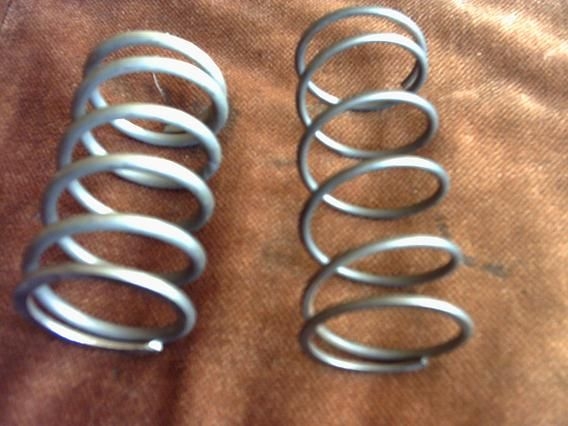
Here is a photo of a 1.9Bar WG spring (on the left) and a stock WG spring (on the right):
RS2'd 93 UrS4 5 spd sedan
94 UrS4 V8 6 spd manual avant
Love it! Took me ages to find the plate, then just as long to get a photo that good, courtesy of my son's iPod being able to fit into really small gaps!
Right then we are back to the fundementals: Code reading and leak testing as mentioned previously.
So do you have any code reading capability i.e Vagcom?
Do you have at the very least a small workshop compressor?
Both of these will go a long way to hopefully solving your problems. You will need some other stuff to permit the leak checking.
The ecu has some diagnostic capability so we might as well see what it says. It might not be definitive but it all helps!
The leak testing involves pressurising the intake system to see whether there any leaks anywhere which might be responsible for the lack of boost pressure. Apart from obvious splits in hoses, there are other less obvious places such as the intercooler O ring, the injectors seats in the inlet and lots of the small bore pipe work. If its a big leak it might be possible to hear/feel it. Other than that its a case of using a spray of soapy water to see what bubbles when under pressure.
The only thing that troubles me is the same characteristic before and after the last upgrade. If it was the same when standard then it implies that something on the car is amiss. We know the turbo was rebuilt but even though it appears to be correct externally its possible that another turbine housing/shaft may have been used. If it was the next size up it would certaintly alter the characteristics somewhat.
Anyway lets start with the things we can test for.
Also you didn't clarify whether you still run that Hyperboost DV. Might consider replacing it with a 710N to eliminate it.
Be interested to see the before dyno run as well.
Well you will never make it as a calendar photographer but I can just make out K24 7200 so it should be an RS2 turbo.
I rotated the photo and blew it up a bit and I *THINK* I can can *imagine* the PN as being 034145703D (I can just see the "D" (maybe)). Which would fit with this:
...The leak testing involves pressurising the intake system to see whether there any leaks anywhere which might be responsible for the lack of boost pressure. Apart from obvious splits in hoses, there are other less obvious places such as the intercooler O ring, the injectors seats in the inlet and lots of the small bore pipe work. If its a big leak it might be possible to hear/feel it. Other than that its a case of using a spray of soapy water to see what bubbles when under pressure..
Herald: Further to what Robin is suggesting, here is a link to some boost testing info that might be handy to read through:
The issue is that you can graft the cold side onto other K26 hotsides. There is a larger #6 56mm and then even worse would be something with a #8 housing! We know the RS2 stuff is unique and therefore expensive and more difficult to obtain.
Unfortunately this could only be verified by physically checking the hotside so we might as well go the tried and tested way of boost leaks/code checking plus casting a suspicious eye over any non original components for starters.
We process personal data about users of our site, through the use of cookies and other technologies, to deliver our services, personalize advertising, and to analyze site activity. We may share certain information about our users with our advertising and analytics partners. For additional details, refer to our Privacy Policy.
By clicking "I AGREE" below, you agree to our Privacy Policy and our personal data processing and cookie practices as described therein. You also acknowledge that this forum may be hosted outside your country and you consent to the collection, storage, and processing of your data in the country where this forum is hosted.


 but I can just make out K24 7200 so it should be an RS2 turbo.


Comment