
WARNING!
If you attempt to replace the injector inserts on the vehicle they may break and fall into the engine. Its more work but the safest method is to remove the inlet manifold. Might as well do all five then!
You should leave the engine breather open but plug the hole in the MAF hose. Anyhow it has exposed one of the overlooked places when searching for leaks.
-
First guess Is that I need these parts for the 3x injectors that are leaking or is it enough with just the O-rings? Is this enough to get the system so much out of balance?
034133555 insert for injector
035906149A o-ringLeave a comment:
-
I refit the valve as it was designed to be fitted and I still have the same problems.
Then it was back to the leak theory and making a safe connection to the air hose. As I'm training a bit on welding I decided to just use bits I had lying around and try to make something that could work and was strong enough to hold the pressure. Still a lot of training left for welding but I was able to secure it properly to the hose and apply pressure to it. Was a lot better than the plastic one I made from pipes earlier that I feared would pop off if I put 1bar pressure on it.

And when I applied 1 bar to it this was the only thing I could spot leaking. I also heard air coming trough the engine as the oil was "bubbling" but I don't know if that's normal or what? I had the breather hose from intake to the vent on the valve cover disconnected and blocked during the test but I guess the air found it's way trough cylinders/valves or somewhere else.

Also shot a short video of it to show how much it was. I detected it on 3 injectors. Think I had approx 1bar when I started to capture this but I left the compressor off so the pressure fell towards the end. http://youtu.be/7LzHKElK_Ug
Leave a comment:
-
I found my dump valve had well bust broke and was totally
Took me a while to find it..
Leave a comment:
-
Ooooh I fitted it the wrong way then! Damn, have to get used to all the good resources on this forum!
It's the wrong way then.. Will put it the other way around first thing tomorrow morning. What could be is that when the spring can't hold the pressure anymore it releases air back into the intake again but doubt it. Anyways like you said it's best to orientate it as Audi designed it. I just put it in like the aftermarket valve was and didn't put more thought to it as I should with this car (wrong cam pulley and now wrong way resirk valve)...Leave a comment:
-
-
In the side out the bottom is how I remember it! It can be fitted either way obviously but as we are trying to troubleshoot it might be better to orientate it as Audi designed it!Leave a comment:
-
Google. Yup. That is a better resource than anything here on this forum.
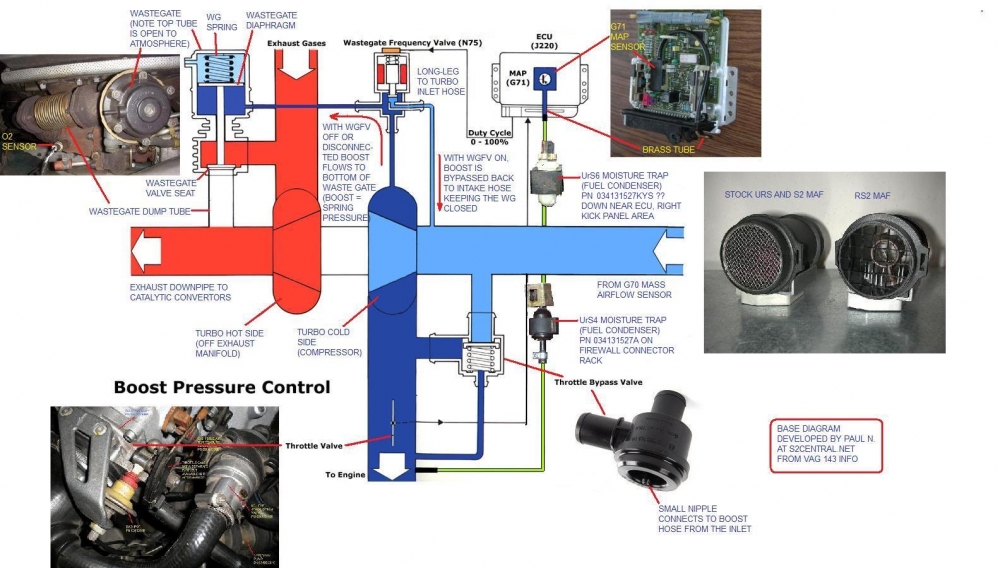
If you would just click on the diverter valve label in this link:
you'd find this (and a bunch more):
Leave a comment:
-
Yeah it was earth for the coils I meant. Will have a look there.
I think so. I oriented it so that the pressure comes onto the "spring" and get's released on the side of it.. I found the picture below on google now just to demonstrate the way it was mounted (don't look at the rest there). Will it even give a difference in performance mounted the wrong way?

Well I do have a megasquirt kit lying around that I soldered up last winter. I could actually hook that up just to log values (not controlling outputs). Still missing sensors tho but there is a MAP sensor built in on the board if I recall correctly so then the turbo pressure could be logged atleast. Also have a broad band lambda sond with two outputs that I could put in. Will def. look into this in my next period off work as it would be cool to have accurate logs for later also.
The car will not be used anymore until I can find out what this is. I also got a weird sound in it after doing the pulley change and it sounds like it's coming from the crank pulley. Prolly me forgetting to adjust that hall sensor I guess so will have a look at that tonight if my GF let's me out there again
Hehe I had that thing before but I got motorcycles to cure that disease as it's a lot cheaper to get a motorcycle to perform This will be a car built back to how it was delivered from Audi and then used on sunny days when not resting in the garage.
Leave a comment:
-
That sounds like just the earth for the coils. If you face the engine, under the inlet manifold at the rear should be some cables attached.
Have you orientated the DV correctly?
Data logging does exist I think but that might mean considering the ecu upgrade sooner than you think! Obviously if the car has a fault that effects it then its better to troubleshoot it before you put any more stress on it. Once its performing as it should and you get used to it, I guess you might be interested in more!Leave a comment:
-
Will prolly update the one that's installed anyways as I want the original setup back. It could be a part of the problem also who knows
Do you mean the cable that's mounted on the top cover and goes from top cover to coil cover? That one I cleaned when I had it open to mount the new oil seal for the valve housing.
On the last tests it was showing 14V while driving. I think the reason it showed 11.5 was that it had ignition/lights on for a while when I was working on solving the issue of not getting connected to the ECU. I did charge it after that while I was putting the car back together. It's less than a year old and I haven't noticed any problems with it yet.
It has a brand new OEM dumpvalve fitted today as it had a aftermarket alloy thing.
Will see if I dare to put 1bar on it I def need to secure my plastic test tool as I'm 110% sure parts will come flying as I apply that pressure on it.
That was how I did the test before but then at a lower pressure. The clamp on that hose never holds 1.8 bar as this is the side of the turbo that's under vacuum and due to the size of the intake there will never be any negative pressure to speak of. If you look at the connection of the MAF you will also see that the pipe is not made the same way as the hose connection that is built to be set pressure on not that it matters as MAF is removed while testing. I will just have to build something from a metal pipe so I can have more pressure on the clamps then it's safe to do it.
Thanks again for good links
Hmm. The guy I bought it from said that it came not long after that he replaced the fuel pump so it could be related to that maybe
Will search some for products for data logging. Would be fun to have a high resolution data logger that could log turbo boost, timing, rev, fuel pressure, oil pressure, temperature, afr and so on instead of having loads of gauges.Leave a comment:
-
I don't think I would rule out fuel pressure either, check the pipe that goes to the fuel pressure regulator isn't split, another simple check before going to far.
Again a boost pressure test would find it.Leave a comment:
-
Minim: Adding to twoqu's suggestion, click on the link to the diagram below and then click on the Diverter Valve label (note: all the labels on the diagram are hot links to more info about those devices, you might want to visit more of them). The ignition coils label leads to coil and spark plug info *AND* a link to a missing and hestitation diagnostic procedure that you might want to check out.
Leave a comment:
-
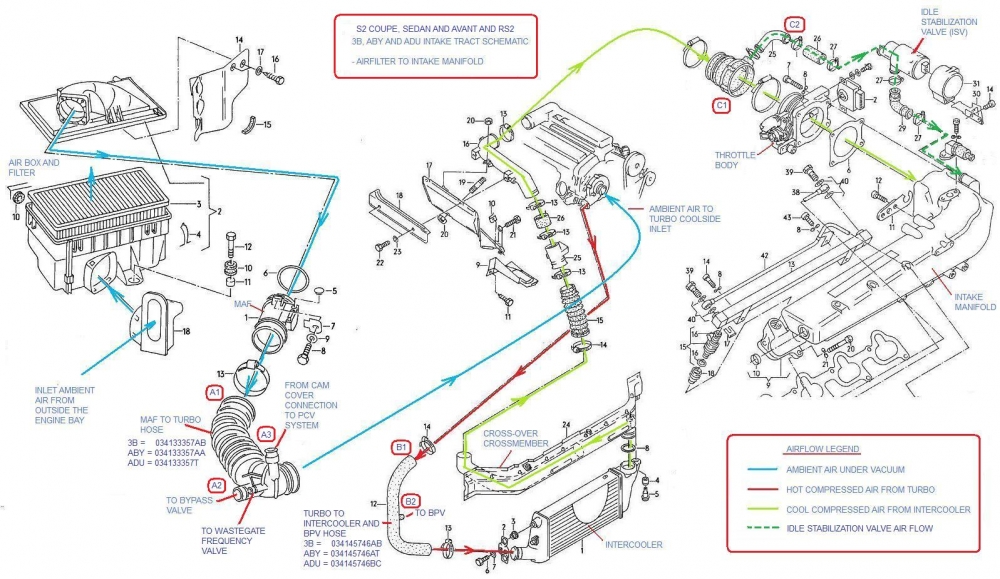
3B, ABY and ADU boost leak pressure testing
Minim: Not sure if you have a boost leak or not but you need to eliminate boost leaks as the potential cause. As Robin (twoqu) says, there are many possibilities for boost leaks, not just in the turbo to intake manifold tract but also in the various PCV and evaporative emissions pipes and hoses if things go bad.
As per his (and prj's) suggestion, to capture all the potential leaks at once, you place the pressure bung in position A1 and you disconnect and plug A3 in the diagram below. If you pressurize to 1 Bar, that should be enough to find a leak. You are worried about the bung blowing off. Remember that the clamp that holds the hose on has no issues at chipped pressures, e.g. 26 psi (1.8 bar boost).
More boost leak testing info: http://www.s2forum.com/forum/showthr...538#post709538
Leave a comment:
-
Does the vehicle have a stock dumpvalve i.e recirculating rather than atmospheric?Leave a comment:


Leave a comment: