

-
-
Is it not adjustable to allow changes to tension? -
duno, are them yellow bit the adustable bits or the tie rods on the end of em?
looks to me like it hinges on the yellow bitsComment
-
Hi Will, the main bar works in torsion and has it's spring in rotation form. Morris Minors, Early VW beetles, Porsches and Challenger tanks use Torsion bars for springs. The yellow arms just extend the rotational force. The photo is a bit misleading in that the arms are probably 6 inches ( 15Cms) long.
DavidComment
-
any one got a picture from the side?Comment
-
Are those Sport Quattro lower a-arms?
Oil cooler on the diff is curious too, looks like a well sorted motor!91CQ20v - Gone to a new home
93UR-S4 - The Magic Carpet
94S2Bus - The Emerald ExpressComment
-
Mmmmm, me likey that! Nothing feels fast for long...
sigpic
2000 Audi RS4 - Kingfisher Blue ~+~ 2004 Audi Allroad 2.5 Tdi - Ebony Black Pearl
Comment
-
Looks like the yellow arms are pivoted on the ends of the bar, but they must be offset by a reasonable amount for this to work - the arms are probably mounted with torsional springing between them and the actual torsion spring of the bar itself. This will soften the effect of the bar. Adjustments can be made by altering the distance from the bar that the yellow arms are displaced by - longer mounting = softer torsion but also increases the lever length to the bar which will further soften the effect. Alternatively the yellow extension mountings may be removable and changed for thicker pieces.
@Stick - aren't Moggy torsion bars direct acting on the pivot of the lower control arm? They're the road spring rather than anti roll, yes?
__MDC__Martin Cutting
aka Keeper of "The Teutonic Kitten"
It's not better than sex, but it runs it a close second.Comment
-
100% correct. It wasn't very clear in my post.Originally posted by Keeper of The Kitten
I wonder what the ARB for a Challenger tank would be like!
DavidComment
-
Looks like it's wearing Toyo R-888's as well.
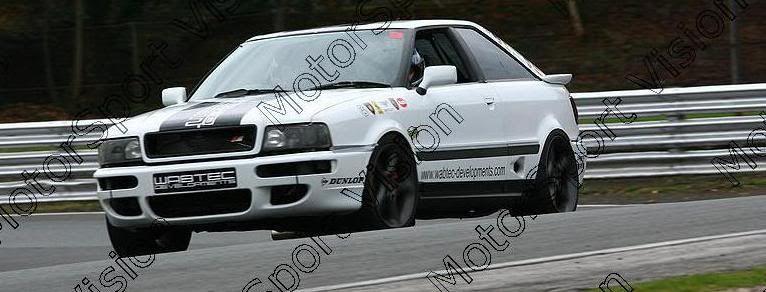
Hmmm. After market ARB, oil cooler on the diff, R-888's, new (? - certainly very clean) hard pipes, wide exhaust... any more details about this car?
Ck.Shocked, exhausted, hosed, bushed, dumped, chipped, mounted, filtered, gauged, packed, intermittantly wiped and braked. I mean broken. Now, about the car...Comment
-
//-\\ ((_)) //)) //Comment
-
-
What diff is that? Notice the propshaft side is one large casting reaching to both subframe mounts
91CQ20v - Gone to a new home
93UR-S4 - The Magic Carpet
94S2Bus - The Emerald ExpressComment
-
Nope, you are almost there.... When you turn the yellow thingys you actually increase the profile of them (looking from the side). This will stiffen them - the higher the profile the stiffer it gets. The thinking behind a ARB like this is that the bar that goes from one side to the other is stiff. Stiff as can be. All of the deformation from bodyroll will be taken up by the "leaf" springs at the ends (the yellow bits). These ARB's are the most common setup in racing.
If you don't believe me try it your self... Take a ruler and then light it from the back, projecting the profile on a wall f.i. If you start where the ruler will just be a thin line and then turn the ruler along the length-axle you will see that the profile increases. The stiffness of a bar increases by the height of it! Easy-peasy...Comment
-
Ahhhh, I've spotted it now!!!!!! Henka, you beat me to it.
Henka is right - those ARB arms are coming out at an angle from mountings in cylindrical bushes on the ends of the bar, and they are indeed blade adjusters!!! When I first looked at this picture I thought they were nearly parallel to the centreline of the ARB (that's what I was remarking on first time I posted), but they are probably about 60 degrees to the bar when viewed normal to the plane that intersects the arms.
You don't really need blades at both ends, that's just a nicety - we used them extensively in single seat cars and touring cars too - in fact, I've designed a few of these! As Henka says, the blade is softer when laid over flat, and stiffer when turned vertical, and varies between those two extremes.
I think a better analogy is to hold a steel rule halfway onto your table and bend it downwards - very easy when it's laid flat. Now stand the rule on edge and try pressing down on it. Much stiffer! The bar itself will be stiff, but will still work as a torsion bar, you set it up to the maximum possible stiffness you think you'll need. Then you use the blade adjuster to soften it.
We had cockpit adjustable versions on some cars, using a push-pull cable and a lever linkage similar to a throttle lever on the end of the blade adjuster. The touring cars had long cockpit levers (both ARBs were adjustable). I designed one for a single seater that had a push-pull cable which could also be fine adjusted by turning a knob on the end of the cable (Japanese FToyota). F3 also had cockpit adjuster but this had to be locked for qulifying and race, as it is illegal for anything other than testing (well, it was when I did F3!)
I'll have to have a dig in my drawing archives now!!!
__MDC__Martin Cutting
aka Keeper of "The Teutonic Kitten"
It's not better than sex, but it runs it a close second.Comment


Comment