
I'm having problems with power steering in my ABH v8 swapped coupe and I wanted to ask a question...
I have a groan that will not go away despite replacing the rack and pump. I have an ABH steering pump modified to disable the brake bomb line by removal of the little cylinders that drive it.
Now I realize that it could be an issue of too much pressure to the rack from the pump.
The coupe and cabriolet racks are 100 bar and the v8 pump is 150 bar.
I asked on my motorgeek thread whether the removal of pistons could help solve this and user "elaw" responded in the negative explaining:
The way that 99% of hydraulic power steering systems work is that the actual pumping mechanism (the vanes) creates a variable flow that depends on engine RPM, and there's a special valve on the outlet that regulates flow by bypassing fluid back to the pump inlet, and can also limit pressure the same way. So the output of the pump is a constant flow with a pressure limit - it's done that way because the way the steering assist responds is related to the flow, and you don't want that to vary with engine RPM.
The way the rack works is that under no load (when no assist is being called for), the fluid just flows through the valve body (in the rack) so the pressure in the system is almost zero. When you turn the wheel and assist is required, orifices in the valve body start to close, causing pressure to build. That pressure acts on the piston in the rack to assist the steering. So the pressure basically is proportional to the force you're putting on the steering wheel, up to the limit set by the valve in the pump. That's why normally the pump is pretty quiet, but gets noisier as you apply force to the steering wheel - it's because the pump is being called on to produce more pressure.
So the bottom line is 1) the pump pressure really doesn't mean anything except when a lot of force is being applied to the wheel because the pressure spec is only the limit and it's only reached when a lot of force is applied to the steering wheel. And 2) if the flow needs changing (which may be what's causing the whining), the only correct way to do it is to recalibrate the valve on the pump outlet.
So to apply to my pump (I have a couple spares including one that's frozen that I disassembled):
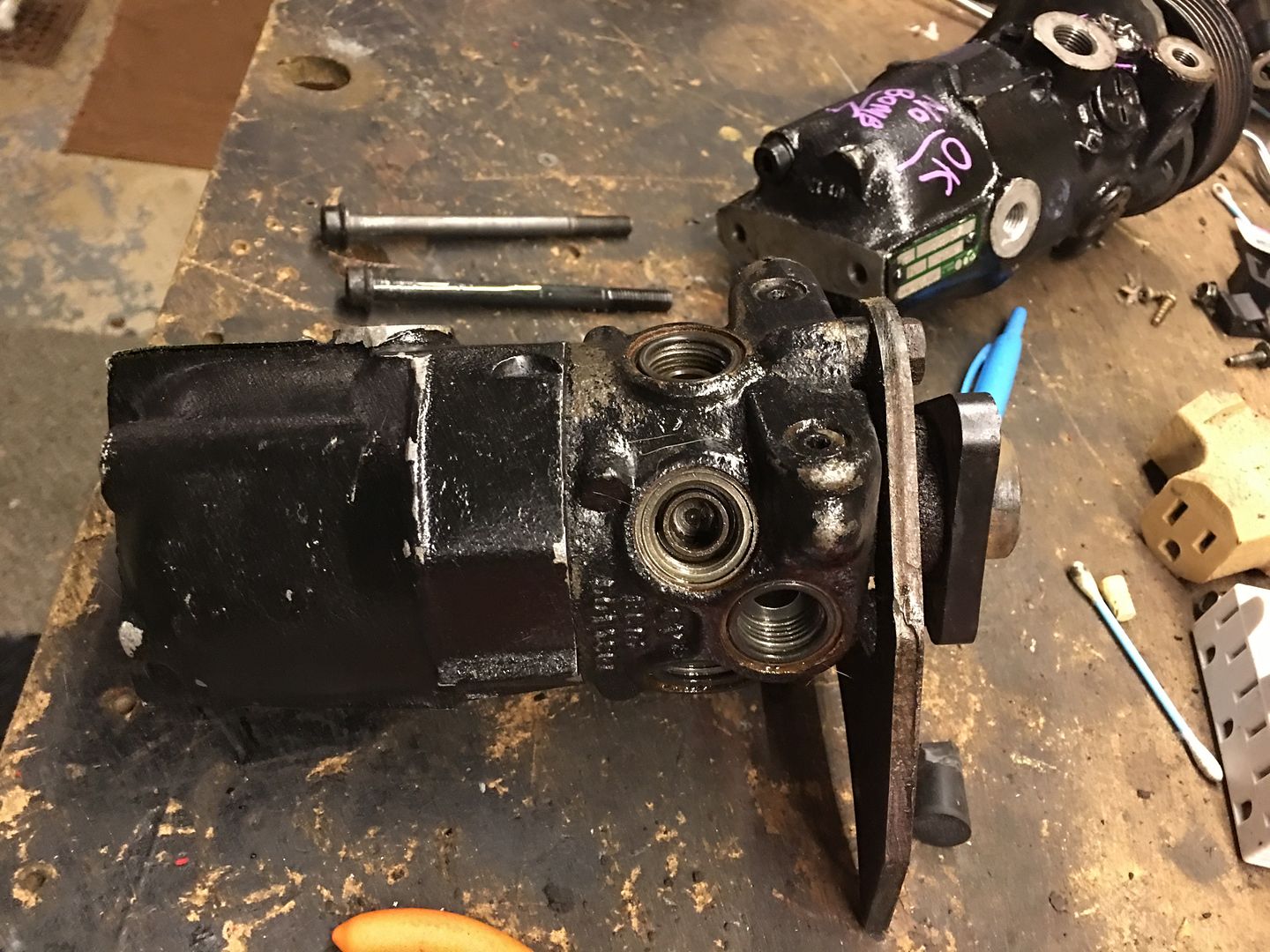 [/url]

#1 - Supply of Pentosin to pump
#2 - three sets of pistons that feed the steering rack
#3 - one set of pistons that feed the brake bomb (these are smaller diameter pistons)
#4 - outlet to the rack
#5 - outlet to the brake bomb
I have disabled the brake bomb section by removing those smaller pistons, rods and springs
Here it is just cracked open (this one is a bad pump I got from Force5 with all the pistons frozen in it)

A - These are fed from the three sets of pistons (#2 above)
B - These line up with A and appear to have one way valves letting pentosin through from A but not backward
C - This (I believe) is the pressure relief valve that sends fluid back to E where it can pump back through the pistons and A
D - this is the little crankshaft that hits each pistpn
E - This flows back into the piston system
I pulled C out from above...

It looks like this:


So in theory, a different relief valve could change this pump from 150 bar to 100 bar?
I took that piece apart to try and figure out how to do so...

It's got a tube with a spring around it on the "return to pistons" end, then a collection of ball bearings that would push against it with a screen ahead of them...

tube / Spring:

Ball Bearings and screen:


So in theory, as pressure builds in the rack (due to not needing flow), the pressure builds in the fat end of the pump.
When that pressure is high enough to push the bearings into the spring and push the tube opening bigger, there is flow back to the pistons.
This would be what sets the pressure of the pump.
So I wonder if a lighter spring would reduce it?
Anyone have experience with this?
I have a groan that will not go away despite replacing the rack and pump. I have an ABH steering pump modified to disable the brake bomb line by removal of the little cylinders that drive it.
Now I realize that it could be an issue of too much pressure to the rack from the pump.
The coupe and cabriolet racks are 100 bar and the v8 pump is 150 bar.
I asked on my motorgeek thread whether the removal of pistons could help solve this and user "elaw" responded in the negative explaining:
The way that 99% of hydraulic power steering systems work is that the actual pumping mechanism (the vanes) creates a variable flow that depends on engine RPM, and there's a special valve on the outlet that regulates flow by bypassing fluid back to the pump inlet, and can also limit pressure the same way. So the output of the pump is a constant flow with a pressure limit - it's done that way because the way the steering assist responds is related to the flow, and you don't want that to vary with engine RPM.
The way the rack works is that under no load (when no assist is being called for), the fluid just flows through the valve body (in the rack) so the pressure in the system is almost zero. When you turn the wheel and assist is required, orifices in the valve body start to close, causing pressure to build. That pressure acts on the piston in the rack to assist the steering. So the pressure basically is proportional to the force you're putting on the steering wheel, up to the limit set by the valve in the pump. That's why normally the pump is pretty quiet, but gets noisier as you apply force to the steering wheel - it's because the pump is being called on to produce more pressure.
So the bottom line is 1) the pump pressure really doesn't mean anything except when a lot of force is being applied to the wheel because the pressure spec is only the limit and it's only reached when a lot of force is applied to the steering wheel. And 2) if the flow needs changing (which may be what's causing the whining), the only correct way to do it is to recalibrate the valve on the pump outlet.
So to apply to my pump (I have a couple spares including one that's frozen that I disassembled):
[/url]
#1 - Supply of Pentosin to pump
#2 - three sets of pistons that feed the steering rack
#3 - one set of pistons that feed the brake bomb (these are smaller diameter pistons)
#4 - outlet to the rack
#5 - outlet to the brake bomb
I have disabled the brake bomb section by removing those smaller pistons, rods and springs
Here it is just cracked open (this one is a bad pump I got from Force5 with all the pistons frozen in it)

A - These are fed from the three sets of pistons (#2 above)
B - These line up with A and appear to have one way valves letting pentosin through from A but not backward
C - This (I believe) is the pressure relief valve that sends fluid back to E where it can pump back through the pistons and A
D - this is the little crankshaft that hits each pistpn
E - This flows back into the piston system
I pulled C out from above...

It looks like this:


So in theory, a different relief valve could change this pump from 150 bar to 100 bar?
I took that piece apart to try and figure out how to do so...

It's got a tube with a spring around it on the "return to pistons" end, then a collection of ball bearings that would push against it with a screen ahead of them...

tube / Spring:

Ball Bearings and screen:


So in theory, as pressure builds in the rack (due to not needing flow), the pressure builds in the fat end of the pump.
When that pressure is high enough to push the bearings into the spring and push the tube opening bigger, there is flow back to the pistons.
This would be what sets the pressure of the pump.
So I wonder if a lighter spring would reduce it?
Anyone have experience with this?




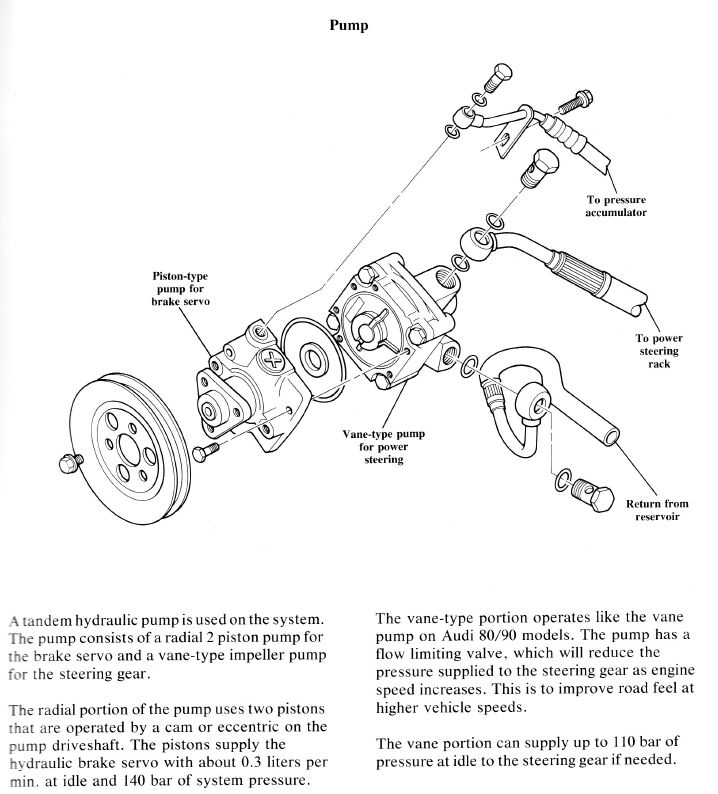


Comment