
I see, well that answers my question regarding MAF/MAP interaction and usefullness.
-
-
Btw, the reaction delay is largely eliminated by using TPS.
And also, that delay might not be that much due to the MAF itself (<15ms reaction time), but also because a system lacks X-Tau compensation and because of long intake plumbing.
The first bit is corrected by proper X-Tau compensation which is needed in all systems and the second bit is corrected by factoring TPS into the equation.Comment
-
Never did post this:
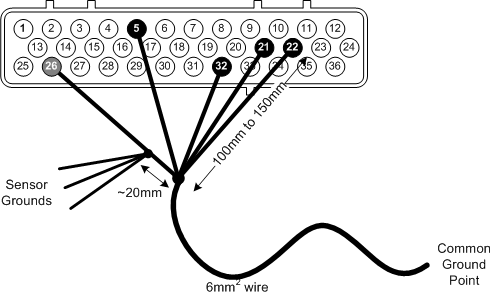
User guide on VEMS to MAF configuration search page for MAF and then Configuring Air Metering
Marcell's thoughts on the MAF
Comment
-
Whoever wrote that article has no idea about mass-airflow.
Completely biased and full of ********.
If speed density was so good then all the OEM's would be using it. They are not, and there is a very good reason for that.
Mass flow is infinitely more accurate on part-throttle conditions than speed density can ever be, especially with changing conditions (VE changes over time).
This is also why all newer Bosch ECU's (starting with ME7) use a hybrid system, where they use mass-flow for accuracy and speed-density for predicting load changes on a faster path.
Besides the rest of the drivel, I love how in that discussion that guy says WBO2 is better than MAF at correcting for engine tolerances.
One simple question rebukes that completely:
* How much is the response time of the WBO2 probe at low-load?
* How much is the average response time of a MAF at low-load?
A hint: those numbers differ by a few orders of magnitude
Generally it is smart to look at what OEM's do and how they do it.
OEM ECU's have speed-density, mass-flow system combined with WBO2, cylinder-individual knock feedback, torque model, etc. That since year 1999 (ME7.5 anyone?).
Also, if you consider the fuel requirements and stringent emission norms, it is a no brainer to understand that OEM's are always using the most accurate way of metering possible at any given time. They actually spend millions on trying to achieve that. Anything >1999 from Bosch is still light years ahead of most standalone ECU's.
The fact that an ECU designed by Bosch in the early 1980's is actually compared on this forum to a modern standalone in one sentence just further shows how crazy good the engineering was then to be able to do what they did with their limited technological resources at the time.Last edited by prj; 23 March 2012, 15:18.Comment
-
First of all i don't want to make any flames on this topic.
I think the main idea on using Motronic is the lack of know-how. If you really want to learn Motronic you will need a very high amount of time for that. To be honest i think the only people that really know how Motronic works 100% are the ingineers that made it. You can make reverse engineering and try to find from the source code how it really works.
I don't remeber that someone said anything about timing control and knocking capability of Motronic. Well for power you need to have a very good timing. Aftermarket systems are on the begining with knocking capability.
Everyone can find some advantages for Motronic and for aftermarket ECU's . But is someone who sees the week points ?
P.S.: For Motronic is hard to use for more than 600hp (like I read) and because you don't have a anti lag system , launch control and traction control .
For aftermarket ECU's the main idea is that you know everything that happens in that "wonder box " called ECU .
This is a very interesting topic because I have the same question : Motronic or aftermarket ECU ?Audi S4 2.2T 5 spd 1992 for parts
AUDI A4 1.9TDI daily use
Audi 80 Quattro 2.0 16V (ACE) aka CompetitionComment
-
No problems with Pro-M maf.
I have both working.and because you don't have a anti lag system , launch control
Which aftermarket ECU has traction control? For proper traction control you need an electronic throttle. Motronic has that since the year 1999and traction control .
Anyway, if you want to tune yourself on a 2.2T engine or want your car purely for drag racing definitely go for aftermarket ecu.
If you are going to pay someone to get it tuned and the usage is mostly for street use, I think it makes no difference.Comment
-
I like where this is finally going. After the p*****g contest finished this topic has become informative.Mass flow is infinitely more accurate on part-throttle conditions than speed density can ever be, especially with changing conditions (VE changes over time).
This is also why all newer Bosch ECU's (starting with ME7) use a hybrid system, where they use mass-flow for accuracy and speed-density for predicting load changes on a faster path.
Generally it is smart to look at what OEM's do and how they do it.
OEM ECU's have speed-density, mass-flow system combined with WBO2, cylinder-individual knock feedback, torque model, etc. That since year 1999 (ME7.5 anyone?).
Also, if you consider the fuel requirements and stringent emission norms, it is a no brainer to understand that OEM's are always using the most accurate way of metering possible at any given time. They actually spend millions on trying to achieve that. Anything >1999 from Bosch is still light years ahead of most standalone ECU's.
The fact that an ECU designed by Bosch in the early 1980's is actually compared on this forum to a modern standalone in one sentence just further shows how crazy good the engineering was then to be able to do what they did with their limited technological resources at the time.
A little background on me. I have been working on Import Cars here in the USA since 1976. I have seen firsthand the development of fuel injection from mechanical type systems on Porsche, Mercedes Benz & BMW's 2002tii, CIS & all of its variants. I saw & learned hands on about Bosch EFI, the introduction of oxygen sensor control, knock control, electronic throttle control, up thru ME9.7 as equipped on Mercedes Benz products. So I know a little about this fuel injection stuff. Yet not being able to tune it (other than "reflash" the ECU via on-line reprogramming) has always frustrated me. I have at my disposal the ability to use a stand alone ECU system, Haltec, & to have great support for it here locally in Lexington, Ky USA. Even installed (not tuned) that system on a Lotus TTV8. I also know that the stand alone systems that are available are still behind when compared to OEM as pointed out above. So, on say an older 5-cylinder 20 valve, how about using a ME7.0 or later from the newer VAG product 5-cylinders, the larger MAF5 & the electronic throttle from a V8 engine? (Thinking of what I saw on an Audi 4.2 or the V8 engine in my Dodge truck) Would that be possible, easily tunable & have the benefit of newer & fastest processors, wide band control, etc? Is there anyone mucking around with this setup yet?
Thanks, Chris"Nulla tenaci invia est via"Comment
-
First of all - there is a way to tune the newer ECU's on the fly, without the need to reflash all the time.
In case of the ME7 series you need a 16 bit emulator.
From the cheaper options, it's a Moates Roadrunner, from the more expensive ones, probably the OLS300.
Then you code the ECU as a test model, and that disables the checksumming when it's operating, so you can modify everything on the fly.
As for fitting one of these units to an I5... well, one needs to find some OEM application.
So that would probably be some turbocharged 5 cylinder Volvo engine. Lift it from there, and then recalibrate it.
I would say it's perfectly possible, but I think there is a lot of effort involved.
An easier, albeit possibly more expensive possibility would be to use one of the Bosch Motorsport ECU's.Comment
-
So you have the anti-lag system working? Does it need some hardware tweaks?
Audi UrS4 Avant 2.5 20vt - twincharged - Project
Audi 80q B4 Sedan 2.2 20vt - Daily user
BMW 320d Touring e91 M-Sport - Daily user
BMW 740iA e38 - ProjectComment
-
Comment
-
So it work like the launch control but also on all gear shifts when flat-footed? That sounds good to me.
Audi UrS4 Avant 2.5 20vt - twincharged - Project
Audi 80q B4 Sedan 2.2 20vt - Daily user
BMW 320d Touring e91 M-Sport - Daily user
BMW 740iA e38 - ProjectComment
-
Comment
-
Just a thought: is it possible to put an analog input for example for a flex fuel sensor to make adjustments?Comment
-
Comment


Comment