-
Prj is thinking that the catalytic converters are plugged. Despite what you say about the used system that you installed was from an UrS that was "running perfect", maybe it wasn't and/or now the cats are plugged enough that they are creating a huge back pressure, causing the car to feel very sluggish because the turbo can't spin up properly. You owe it to yourself to remove the exhaust from the cat's back (on a lift, in one piece (or whatever)) so you can feel how the car responds without any exhaust restrictions. (It will be a bit loud during the test). -
Well, taking the system off can wait I guess - post up the engine bay first
Also, leave the O2 sensor unplugged, don't plug that back in.
If that doesn't give any difference - plug everything back in, then drive around a bit, and after driving around, log Group 000 with vag-com or make a screenshot of the 10 values.Leave a comment:
-
I've not tried removing it, but the system (downpipe back) is again off onother car which was running perfect Is it still worth trying??
I'll definitely try unplugging the 02 sensor though and the ecu as you mentioned!
I'll take a snap of the engine bay and post it up as soon as i can.Leave a comment:
-
-
-
Yes mate, i push it in and out of the space in the garage i keep my cars in on my own and it rolls fine.
Its hard to describe without driving it. If it were an old car with a dizzy i'd say it was way too retarded but according to vag-com its far from the case. Just feels dead lazy, even free-reving it feels ****!!Leave a comment:
-
Tested the fuel pressure under load today with two different gauges at full throttle in 3rd 4th and 5th and it was 4bar plus boost pressure on every run! Car is so so flat now out of boost range (pulling off at 1500rmp for eg) it barely pulls its own weight and feels forced under boost.
Is there anyone near-ish to me who knows their stuff willing to help??
Am i right in thinking the best next step is to obtain a WB02 sensor kit to make sure weak running is the issue??
Leave a comment:
-
-
Unless you are relayed I really doubt that you have anything close to 14V at wide open throttle based on previous research that I and another local Vancouver UrS-club member conducted. I quote:
"As provided by the factory, this pump receives power via a circuitous route: Power from the battery (under the rear seat) is fed forward to the central relay panel under the steering column. Turning the ignition on and starting the engine energizes relay No. 6 in that panel. This sends power from the relay via a green wire to Fuse No. 17, a 20 amp fuse, in the panel on the left end of the dash. From there power goes all the way back to the fuel pump in the trunk by the ski sack in a yellow striped green wire. Based on that route, the car started and 13.5 V or so at the battery, the voltage at the fuel pump is about 12.4 to 12.5 V, i.e. a loss of over one volt. This may not seem important but because the speed of the pump is related to the voltage, the fuel flow and pressure are also related to the voltage at the pump.
While testing the fuel pump voltage while driving (via a tee-connection, 6 ft of wire, the zippered hole in the ski sack, appropriate spade connectors and a digital multimeter), I noted that voltage to the pump dropped (e.g. to 12.2 V) while driving and specifically even more so (down to 11.82 V) under wide open throttle (WOT). Sean did some static testing of the fuel pressures under simulated boost (small compressor connected to the fuel pump regulator vacuum/boost port). He found that, with the engine off, at 11.75 volts (via a switched cable from the + post in the engine bay to the right side of Fuse 17), the boost/fuel pressures were as follows: 0/57,10/65,20/72, 28/80. However, since we are running RS2 turbos and injectors and a new OEM 4.0 Bar (58 psig) fuel pressure regulator, the software wants more from the fuel pump, e.g. 0/58,10/68, 20/78, 28/86. So, since we were potentially short by up to 6 psi of fuel pressure, it was clear that at least there was a possibility that the pinging we were experiencing under WOT was potentially related to low fuel pressures resulting from low voltage at the fuel pump.
To test this more, with the engine off, Sean connected his switched static power lead directly to the battery and tested the simulated boost-controlled fuel pressures again. This resulted in 12.4 V to the fuel pump and boost/fuel pressures of 0/57, 10/65, 20/75 and 28/83. The point is that at the higher simulated boost pressures (20 and 28 psig ), the increased voltage (from 11.75 to 12.4 V) yielded an increase 3 psi. Although this was still 3 psi short of the required 78 and 86 psig, respectively, it showed the potential that directly relaying the fuel pump to the battery would help us to "turbo charge" the fuel pump and get more flow and/or pressure. (NOTE: Dave F. talked to a technical rep at Bosch USA who said that low voltages are worse than higher voltages and that the fuel pump could handle up to 16 VDC so the regulated 13.5 V from an alternator should be "no problem")." (end quote)
REF: http://forums.quattroworld.com/s4s6/msgs/24327.phtml
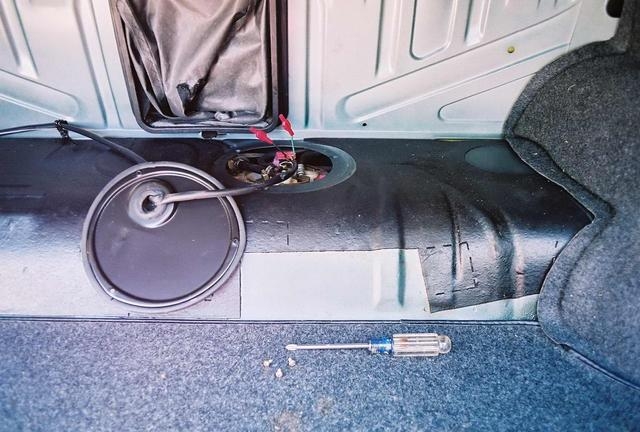
This photo shows the taps that I installed at the top of the fuel tank to measure voltages going to the fuel pump under different boost levels while driving:
Leave a comment:
-
-
-
5 years?
You're not very good at finding time
But I'd need logs from the car. WBO2, plus fast data logging, and I could at least see what's going on.
That's not going to happen without me physically looking at it though
Leave a comment:


Leave a comment: