There are two options - you get a pressure test kit, or you sell/break the car.
There are a million places where it can leak from and you are never going to find it without a pressure tester.
-
I would check the temp sender on the back of the head and the o2 sensor.Leave a comment:
-
Not if I can see hole in it it's not, bearing in mind I don't have a pressure testing kit to hand. Plus it was full of oil when I pulled it off, so I'd expect to see some oil spray from a hole if there was one.Leave a comment:
-
Have you pressure tested the car ?
Pulling off hoses is a waste of time.Leave a comment:
-
I took the Michelin Man hose today and other than being full of oil, there's nothing wrong with it that I can see, it actually looks pretty new. There is also no play in the turbo shaft. The saga continues.Leave a comment:
-
-
Or block it off, since it's useless.
Correct.Boost testing is a multi-step/repeat process until there is no more (significant) leaks.
Most people for some reason do not test the multitude of systems attached for the inlet manifold thus resulting in huge overtime during mapping process because the car does not make any boost and is pig rich.
I flat out refuse to map anything before pressure testing it these days.Leave a comment:
-
Air or liquid will always find the path of least resistance to escape. If the one-way valve is stuck open, there will be a "boost" leak at a lower pressure (if you can even build *any* pressure) that won't open up a split in a boost hose (typically the AAN Michelin Man hose splits only open up at higher boost pressures). So before you are done, you first have to replace the one-way valve and then retest to find the other leaks.
This is *NO* different than first isolating the boost hoses (eliminating the PCV system from the test) and pressurizing, finding the leak(s) and replacing the problem hoses/clamps/O-rings and then re-testing to find you still have a boost leak via the PCV system one-way valve.
Boost testing is a multi-step/repeat process until there is no more (significant) leaks.
Can we agree on that?
Leave a comment:
-
I already wrote before:
The only other reason would be a hole in one of your pistons.
Some air is supposed to come out of there, as it leaks past the rings, but very little - a minute amount.
The reason to decouple it from the intake is to prevent pressurizing the sump and having the oil rise up.Leave a comment:
-
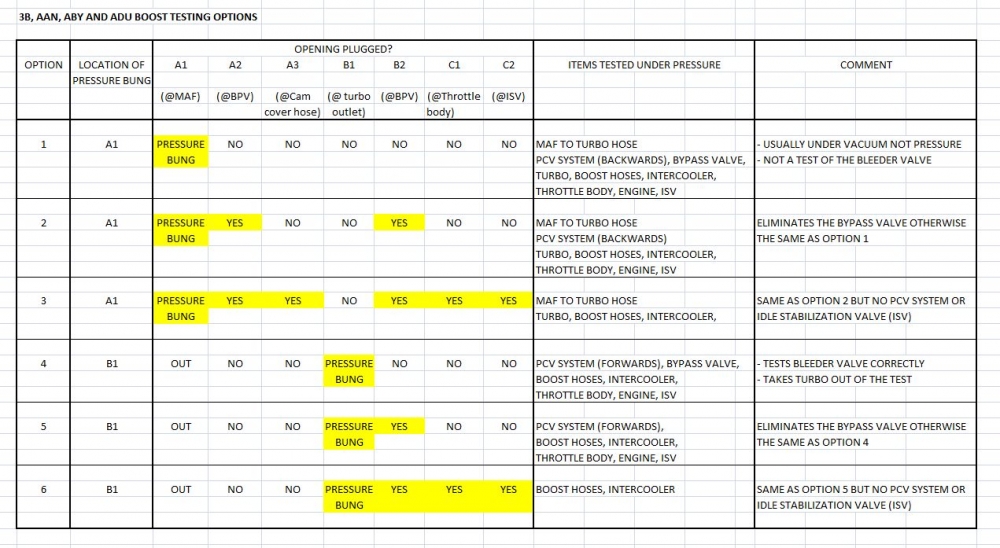
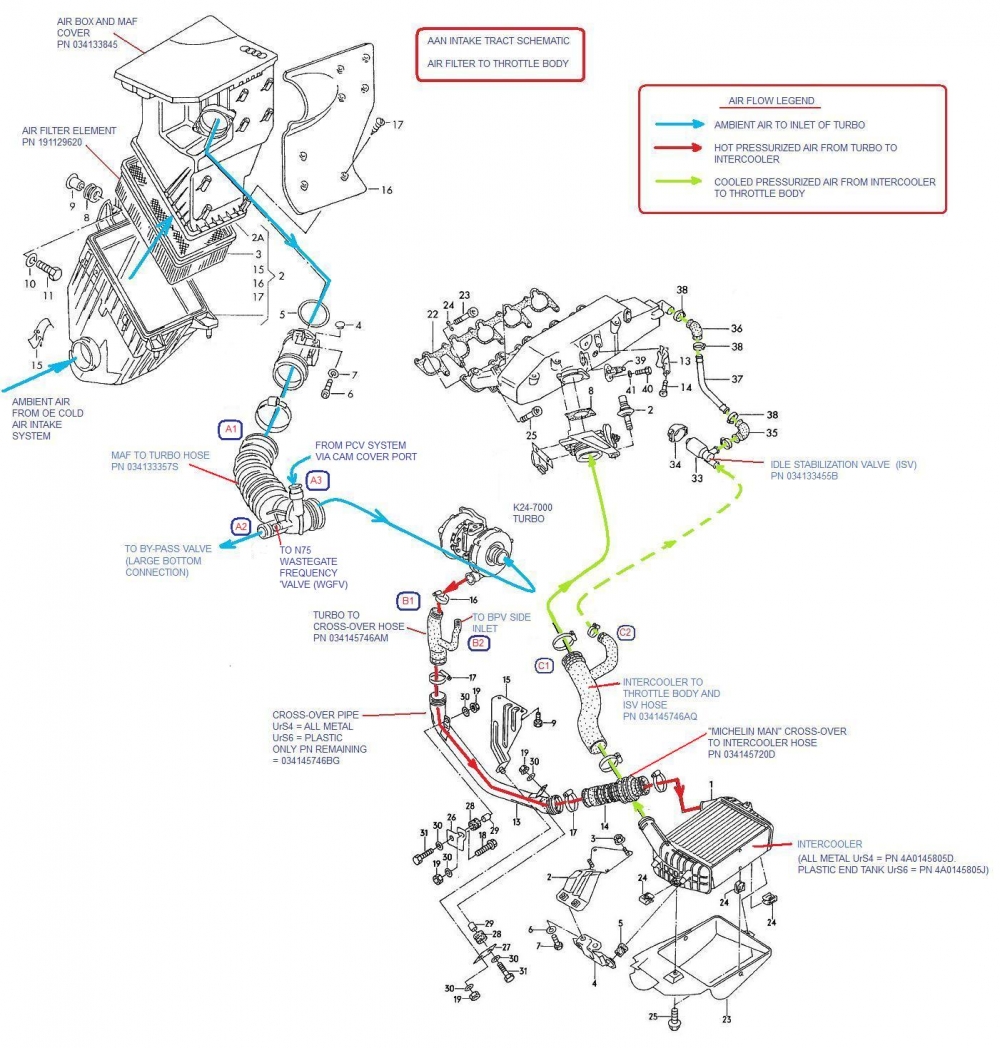
Location [A3] *is* the hole in the MAF-turbo hose formerly connected to the cam cover port. So we agree on that.
So given [A3] is plugged as above, let's say I follow your (good) suggestion that the cam cover vent hose/port remains unblocked and during the pressure test with the pressurizing bung at the MAF end of the MAF to turbo hose produces air flow out of the cam cover port, what is your conclusion? (It's a trick question).
Leave a comment:
-
Huh no. You only need to remove the hose from the MAF-Turbo hose, block the hole in the MAF-turbo hose, and leave the hose/pipe that comes from the cam cover to atmosphere.
Under no circumstances should you block the hose/pipe that comes from the cam cover, unless you want a huge amount of blue smoke afterwards.
That way the PCV system does not get pressurized at all, because it's vented to atmosphere.
If you want to specifically test the PCV system, then after you are done with every thing else, put a minute amount of pressure in with the PCV system plumbed in as on a running car, maybe 0.1-0.2 bar. It's not supposed to hold any more than that.Leave a comment:
-
At least we agree that blocking the PCV outlet on the MAF turbo hose (at the location I labelled as [A3] in my AAN air flow diagram) is needed to prevent putting pressure backward through the PCV system.
"Pressurizing any other way than plugging the MAF, blocking the PCV outlet on the MAF turbo hose and maybe pinching the wastegate hose is a complete waste of time"
That is a good option too. I will revise my Option list to include it as "Option A4".Leave a comment:
-
You do not need to isolate anything. All this is under pressure each and every time you are under boost. So it only makes sense to pressurize everything.
The PCV system never gets pressurized this way. Ever. If everything you put in leaks out of the PCV then you know the one way valve under the manifold is shot.including NOT pressurizing the PCV system backwards.
Pressurizing any other way than plugging the MAF, blocking the PCV outlet on the MAF turbo hose and maybe pinching the wastegate hose is a complete waste of time. Unfortunately very commonly done in the UK due to being wrongly advocated on this forum, and results in me having to fix tons of leaks before mapping two thirds of the cars that are supposedly "pressure tested".Leave a comment:
-
Bit harsh?
Blocking off the throttle body and ISV inlet hose play out in only 2 of the 6 options I put forward for consideration as boost testing OPTIONS (Options 3 and 6). The different options allow for the isolation of areas of potential leaks, including NOT pressurizing the PCV system backwards.
Leave a comment:
-


Leave a comment: