You can change the style the forum displays by selecting your preferred style at the bottom left of the site.
We have made an enhancement so that old threads should now link from search results to the correct thread. This is not yet in place for single post links
Does anyone remember how many Nm torque to be used on the 6mm allen bolts for the inlet manifold? In the AAN workshop manual it only says " Intake manifold, use allen socket V.A.G 1669 to remove and install" and nothing about torque for the bolts.
Same goes for the inserts for the injectors. I kinda fear to overtorque them as it's only plastic ^^ Will continue to search trough the manuals
Edit: can i use ABY specs of 25Nm. Not sure if it's the same bolts.. Also the aby motronic workshop manual is missing the torque for the plastic inserts.
Well the good news is the clamp clearly was doing its part and stayed firmly in place. Bad news is you didn't even try to open the clamp up so the hose could potentially be pulled off in one piece.
I don't have the proper Oetiker clamp tools but I have found that if I open (loosen) the clamp with an awl (see below) in the clamp "eye", I can later close it again with pincher pliers (see second photo):
I was opening them with a flat skrewdriver that I turned around once I got it in. Worked quit fine in the two others I removed first but here it snapped off without much force will get me new clamps and hoses when I go to pickup the new parts tomorrow and a tool to put them on with.
When I was removing the inlet manifold I also had to remove the pressure hose that goes to the MAP sensor and that one didn't take much stress A picture of how it looked when I put some force on it trying to take it off.
Well the good news is the clamp clearly was doing its part and stayed firmly in place. Bad news is you didn't even try to open the clamp up so the hose could potentially be pulled off in one piece.
I don't have the proper Oetiker clamp tools but I have found that if I open (loosen) the clamp with an awl (see below) in the clamp "eye", I can later close it again with pincher pliers (see second photo):
You might get lucky and they come out in one piece. Just need to clean the threads as best as possible.
Another alternative to gasket sealer is ptfe tape used for plumbing. They really shouldn't need to come out again in the cars remaining lifetime unless damaged.
Ok. I'm not sure what's the best choice. The gasket sealer I know is specced for lasting 350 degrees now that I checked but the pfte tape I have doesn't have any spec's for heat so I'm not sure how that is going to be after some months with on/off heat.
When I was removing the inlet manifold I also had to remove the pressure hose that goes to the MAP sensor and that one didn't take much stress A picture of how it looked when I put some force on it trying to take it off. Wouldn't be surprised if this had some leaks also that I didn't notice when I was testing. Will look up on what kind of hoses I need and replace those as they seemed to have done their job in this car.
You might get lucky and they come out in one piece. Just need to clean the threads as best as possible.
Another alternative to gasket sealer is ptfe tape used for plumbing. They really shouldn't need to come out again in the cars remaining lifetime unless damaged.
WARNING!
If you attempt to replace the injector inserts on the vehicle they may break and fall into the engine. Its more work but the safest method is to remove the inlet manifold. Might as well do all five then!
You should leave the engine breather open but plug the hole in the MAF hose. Anyhow it has exposed one of the overlooked places when searching for leaks.
All the parts are now ordered and will be picked up tomorrow at my dealer but got kinda curious with this. Is the inserts glued or how are they attached to the vehicle since it was easy to break them? In case it's a special way to install them, are there any guides out there?
I ordered gasket for the intake manifold so that's coming off so I don't get parts falling into my engine.
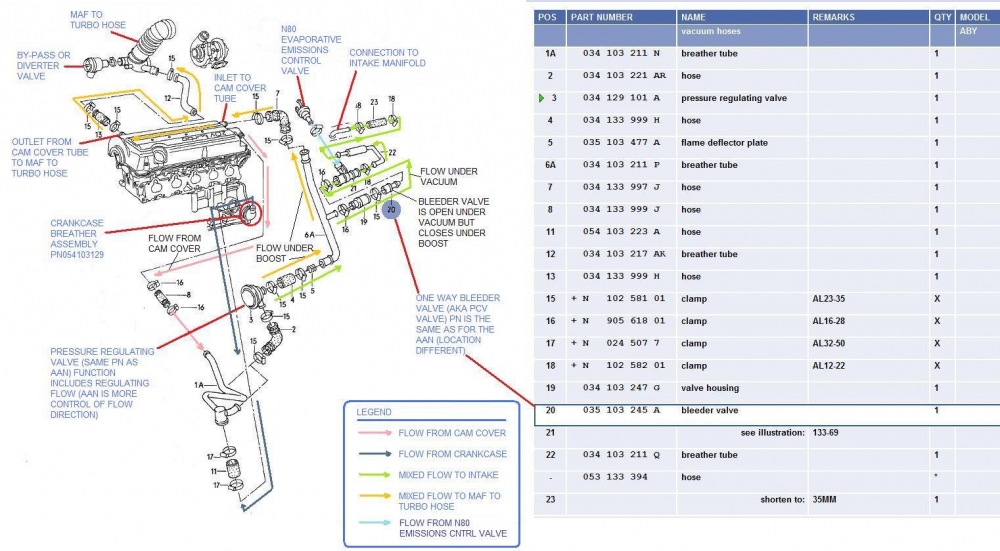
Primarily the bleed valve is to prevent systems that normally only see vacuum getting a blast of boost. The PCV valve does not close completely as it has a smaller orrifice in it to limit the flow when under boost.
Whilst not encouraging you to throw money at it, basically you might as well consider replacement if you are removing the inlet. You can then also play hunt the flame arrester and clean it. It will be all gunked up if its there. That way you should be confident the PCV system is ok.
You are prolly right. Checked the price on online-teile.com now and it's actually just $40 for those two valves if I checked the correct ones. Better off just replacing them as it cost more in time to not do it while the intake is off ^^
Primarily the bleed valve is to prevent systems that normally only see vacuum getting a blast of boost. The PCV valve does not close completely as it has a smaller orrifice in it to limit the flow when under boost.
Whilst not encouraging you to throw money at it, basically you might as well consider replacement if you are removing the inlet. You can then also play hunt the flame arrester and clean it. It will be all gunked up if its there. That way you should be confident the PCV system is ok.
If you remove the one-way, non-return, bleeder valve I guarantee that boost test air will go through the PCV system and come out of the vent tube on the cam cover. Not really much need for the test. If you get air coming out of the cam vent, then you have bleeder valve issue. Solution: Replace bleeder valve.
I don't get a direct high pressure out from the breather line. I would have noticed that but I guess some pressure is coming out there since some pressure will get into the engine and if the breather system are working some should come out that way and not in the intake since the intake is under pressure. Will do a quick check tomorrow morning before I order parts for the injectors.
...I guess I have to remove the non-return valve and check that while it's out and then refit that if it's ok. With everything assembled again I can see if the pressure control/regulator valve is working with seeing that air comes out from the valve cover pipe when I put pressure into the system again.
If you remove the one-way, non-return, bleeder valve I guarantee that boost test air will go through the PCV system and come out of the vent tube on the cam cover. Not really much need for the test. If you get air coming out of the cam vent, then you have bleeder valve issue. Solution: Replace bleeder valve.
Your bleeder valve (item 20 below) might be dead, allowing boost into the PCV system.
If I got this correctly now the non-return valve should be closed so that air doesn't get from the intake manifold and over to where the pipe comes out at the side of the valve cover BUT vented air should get out this hose on the valve cover coming from the crankcase ventilation system? How can I tell where the air is going?
I guess I have to remove the non-return valve and check that while it's out and then refit that if it's ok. With everything assembled again I can see if the pressure control/regulator valve is working with seeing that air comes out from the valve cover pipe when I put pressure into the system again.
And when I applied 1 bar to it this was the only thing I could spot leaking. I also heard air coming trough the engine as the oil was "bubbling" but I don't know if that's normal or what? I had the breather hose from intake to the vent on the valve cover disconnected and blocked during the test but I guess the air found it's way trough cylinders/valves or somewhere else.
Your bleeder valve (item 20 below) might be dead, allowing boost into the PCV system.
The Audi Enthusiast website. Forums for all Audis including A4, S4, A5, S5, A6, S6, allroad, A8, S8, TT, R8, Q5, Q7, 4000, 100, 200, v6, v8, vintage, local forums
WARNING!
If you attempt to replace the injector inserts on the vehicle they may break and fall into the engine. Its more work but the safest method is to remove the inlet manifold. Might as well do all five then!
You should leave the engine breather open but plug the hole in the MAF hose. Anyhow it has exposed one of the overlooked places when searching for leaks.
Ooh.. Will def. do this careful then. Yeah if I'm taking of the inlet manifold I'm doing all five at once since I will have to get a new gasket for that one also.
The breather was open from the valve cover and I also had the plug for oil filling left open just to be sure pressure could not build up inside the engine and ruin any seals. Guess that isn't a big problem at 1bar anyways but better safe than sorry.
We process personal data about users of our site, through the use of cookies and other technologies, to deliver our services, personalize advertising, and to analyze site activity. We may share certain information about our users with our advertising and analytics partners. For additional details, refer to our Privacy Policy.
By clicking "I AGREE" below, you agree to our Privacy Policy and our personal data processing and cookie practices as described therein. You also acknowledge that this forum may be hosted outside your country and you consent to the collection, storage, and processing of your data in the country where this forum is hosted.


 will get me new clamps and hoses when I go to pickup the new parts tomorrow and a tool to put them on with.
 A picture of how it looked when I put some force on it trying to take it off.




Leave a comment: