You can change the style the forum displays by selecting your preferred style at the bottom left of the site.
We have made an enhancement so that old threads should now link from search results to the correct thread. This is not yet in place for single post links
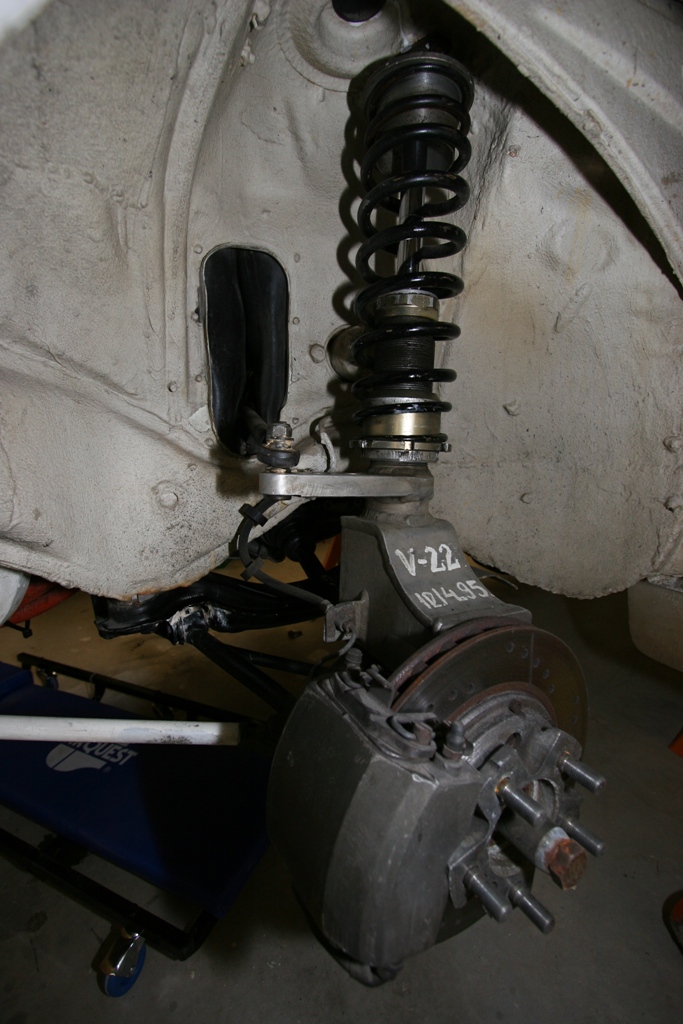
Yeah Al (Stiglet) used them on his CQ, they barely cleared the 280mm G60 discs, infact I seem to remember he had some rubbing issues with them. So definitely would not work with the usual brake upgrades i.e. 314s / 323s. You'd need a rotor with a really low hat height and them some custom caliper carriers.
Personally I don't like them, bit of a bodge and I wouldn't trust them on the road, the shear forces are probably huge when you hit a pothole or the like. Maybe Rusty can do some calcs
Thats what I get for posting when I should be asleep, what I was thinking of was moving the subrame up slightly to get better arm angle, limited room to move up though, and leave space for anything between the subframe and the body.
A guy on motorgeek made his own subframe from big box section with wishbone mounts high up to get a better wishbone angle on a lowered car.
Has anybody tried BJ extenders on an S2? Or is that a bad idea?
I have only seen photos of them used an b3/4s in America and I think stuff was spaced out to make them fit/clear the disc.
Yes if you space the subframe down you will lower the roll centre aswell as more positive camber under compression like Andy says, so overall not good!
That's not the best idea as the wishbone angle will then encourage positive camber under high suspension deflection. What you need are balljoint spacers but there's not really enough space.
You can make up special wishbones, but the limiting factor is the hub design as you can't gain much more than about 2deg of caster before the wheel will foul the arch. A few people have cut the tops off their suspension turrets and fabricated mounting for more conventional adjustable top mounts, so they can get up to around 8deg of caster, maybe more I can't remember. They also are able to get a lot of camber which is also welcome for driving on track.
I am working on a design for a custom hub / bearing carrier and bottom ball joint arrangement, because not only can you gain approx 4deg of caster (giving about 6deg total) but also equally importantly it is possible to raise the roll centre significantly which combined with the camber recovery gained through extra positive caster will make a massive difference to the handling.
Are you going to have them made in alloy? Could save a bit of weight as well as all the other advantages!
You can make up special wishbones, but the limiting factor is the hub design as you can't gain much more than about 2deg of caster before the wheel will foul the arch. A few people have cut the tops off their suspension turrets and fabricated mounting for more conventional adjustable top mounts, so they can get up to around 8deg of caster, maybe more I can't remember. They also are able to get a lot of camber which is also welcome for driving on track.
Any photos anyone ?
Originally posted by Error404
I am working on a design for a custom hub / bearing carrier and bottom ball joint arrangement, because not only can you gain approx 4deg of caster (giving about 6deg total) but also equally importantly it is possible to raise the roll centre significantly which combined with the camber recovery gained through extra positive caster will make a massive difference to the handling.
In terms of squat, a rally car will run much softer springs than a drag car, so it's not really a valid comparison. Just look at the modern WRC stuff on a tarmac super special before heading off to gravel tracks with jumps and bumps, it's like watching mother's stock shopping car being driven by their 17 year old son
Questions is what is the influence of the shape of the control arm and relative position of the BJ pivot point on suspension geometry?
Appreciate any comments.
The shape doesn't make any difference, it is only to clear other parts. It is the relation of the two point connected that makes the caracteristics.
Any one who ever jacked up the front knows the massive bump/roll steer you encounter.Can only be overcome to change the steeringrack location or changing mounting location on the strut to get them more levelled (in-line) in stead of pointing forward. It is messy because the gearbox is sitting in the ideal location for the rack.
Not sure what they did on the Works typ85 but it can be overcome:
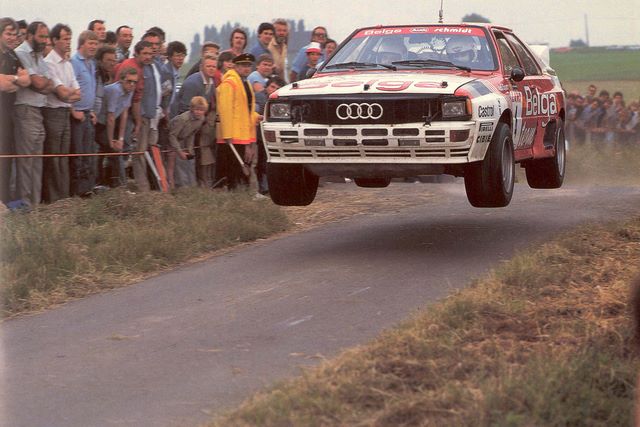
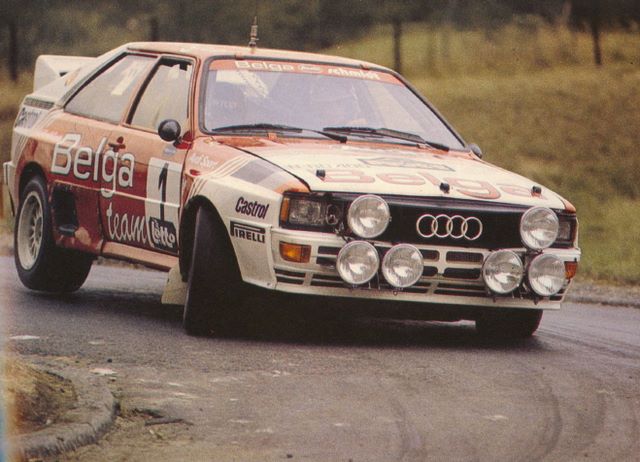
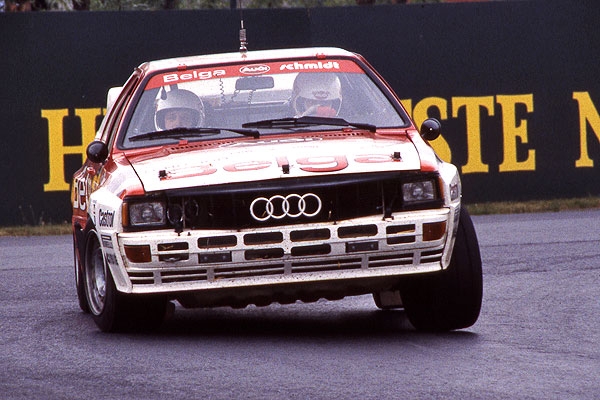
As for rear wheel lifting, they all did it on accel/decell but it does look like some big castor levels up front. While cornering jacking it down which makes the body tilt lifting the rear inner wheel:
But in some pics the outer wheel with this combo looks perfect, tire nicely perperndiculair to the road surface. Rim nicely hanging in tire sidewall:
It amazes me that lifting a rear wheel is possible knowing the amount of weight (rear wheel pressure) in the back. Relation between front/rear roll stiffness & bars does contribute to this, in the end i reckon the engineers were looking for maximum front grip to overcome understeer and did not want to increase inbound dampening just to keep the car leveled.
Lifting the rear is not ideal, some braking opportunity is lost there but not crucial. All fast FWD's do this with grippy rubber (since there is no weight in the back end)
Stock setup does not lift:
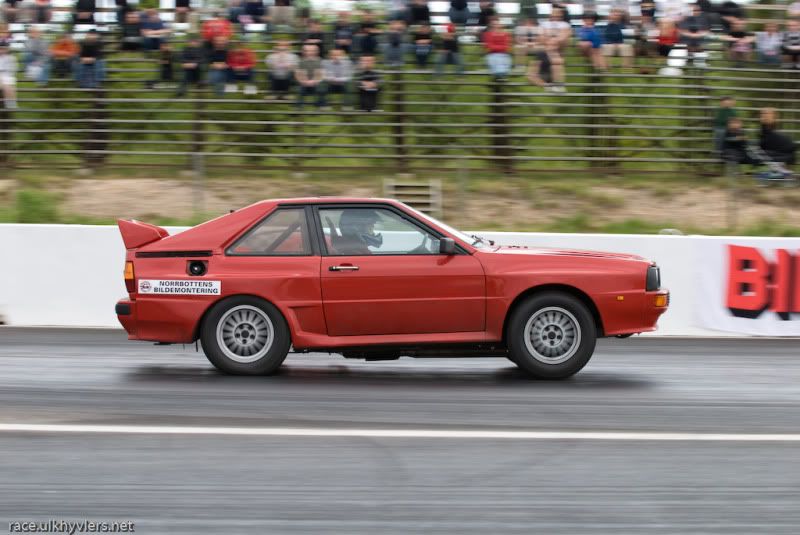
On the Short chassis i did see some subframe spacers on all models. Now this is a neat trick to change the roll axis of the car which will improve handling. Next to that having the wishbones more horizontal will always improve handling.
Something you will see on the S1's is due to the massive acceleration is lifting of the nose. I thought this was due to squatting of the rear (could be overcome with some anti lift/dive geometry which is not easy to create on the current design) but if you look closer it seems like it is lifting the front shocks!
This replica (850hp) seems to be squatting a bit but could be low rideheight to start with:
Zlatkov's S1 replica does not suffer from this, i think due to newer 4-way adjustable shocks (which were not available back then?)
You can make up special wishbones, but the limiting factor is the hub design as you can't gain much more than about 2deg of caster before the wheel will foul the arch. A few people have cut the tops off their suspension turrets and fabricated mounting for more conventional adjustable top mounts, so they can get up to around 8deg of caster, maybe more I can't remember. They also are able to get a lot of camber which is also welcome for driving on track.
I am working on a design for a custom hub / bearing carrier and bottom ball joint arrangement, because not only can you gain approx 4deg of caster (giving about 6deg total) but also equally importantly it is possible to raise the roll centre significantly which combined with the camber recovery gained through extra positive caster will make a massive difference to the handling.
Very interesting topic as I am busy with converting my Type 85 track car to S2 suspension.
I note the position of the ball joint relative to the hub center is set forward on the S2.
Mounting on the existing BJ will move the wheel back, if the calipers are to at the rear.
Caster will be increased, if the BJ can be moved forward and wheel stays in same place.
Assume that by swopping struts around, the castor is in fact reduced and trail is negative.
Would prefer to use the S2 control arms as prefer the three bolt mounting of the ball joint. However, from what I can see , despite the the S2 control arms being a differenet shape, with the ball jopint fitted, the pivot point is in the same position as the Type 85 setup.
However, If I swop the S2 BJ's around (Right on left and visa versa) the position of the wheel remains unchanged (+-), but caster will increased as the BJ pivot point is then moved forward and should be a close match for the S2 strut.
Alternatively could have special control arms made up. Questions is what is the influence of the shape of the control arm and relative position of the BJ pivot point on suspension geometry?
Its always worth asking as usually somebody else has looked at it and come up with some answers!
Great pictures of the wrc fiesta! Not suprising its reacting the way it is with what looks like a full gravel set up. I think part of the brief was to keep the tyres in contact with the gravel/ dirt as much as possible.
As for the prospeed car picking up a rear wheel surely thats largely due to running a stiff rear anti roll bar? Its something I am expecting mine to do which will help dial out the understeer.
We process personal data about users of our site, through the use of cookies and other technologies, to deliver our services, personalize advertising, and to analyze site activity. We may share certain information about our users with our advertising and analytics partners. For additional details, refer to our Privacy Policy.
By clicking "I AGREE" below, you agree to our Privacy Policy and our personal data processing and cookie practices as described therein. You also acknowledge that this forum may be hosted outside your country and you consent to the collection, storage, and processing of your data in the country where this forum is hosted.







Leave a comment: