You can change the style the forum displays by selecting your preferred style at the bottom left of the site.
We have made an enhancement so that old threads should now link from search results to the correct thread. This is not yet in place for single post links
Yeah, well the MAF has been like that for over a year. Didn't experience any issues with it.
If the MAF does not create the correct signal, the ECU will under/over fuel the cylinders and, unless the O2 sensor can give the needed feed back, to the ECU, you end up with a mixture adaptation issue.
Yes, I remember the plugs... But this is different because I did check the air and vacuum lines, while the plugs went untouched until the very end...
For the record, today, I went over all hoses & connections with a carb cleaner (if theres a leak, then the idle starts to fluctuate) and with a leak finder spray. Nothing. The idle is rock solid at 880 and the leak spray did not bubble.
Yeah, well the MAF has been like that for over a year. Didn't experience any issues with it. I hope it stays alive for approx. one more year, after that I'm switching to speed-density. [emoji16]
Did a MAF test while I was at it, just to be sure. The readings do not differ from those I made last summer.
Sometimes when you are sure that something cannot possibly be the problem, after much effort to find another solution, it turns out that the "inconceivable" part is indeed the problem. That should sound familiar to you.
Based on the MAF testing worksheet that I created (and I think you used (except your printer has a phobia to "l" (ell): http://12v.org/urs/G70_MAF_TESTING_WORKSHEET.pdf , I think your's failed on a couple of issues (low voltages in two cases).
Here were my results from back when:
1. Testing for ground: Disconnect the harness connector from the MAF. Set your DMM to 20 ohms and look for continuity between Pin 1 (Pin 6 is the empty position) and ground on the engine or chassis. My result = 0.5 ohms = continuity = there is a ground for the MAF = good to go so far
2. Testing for connection to the injector circuit: Turn the DMM to 20 VDC. Connect to Pin 5 and ground. Turn on the ignition. You should get some positive DC volts. My result: 11.1 V = good
3. Checking MAF function: With harness connector removed, switch DMM to 200 ohms. Connect DMM probes to terminals 1 and 2 on the MAF (1 is on the right, 6 is on the left). Record the resistance. My result: 0.000 ohms
Disconnect leads and "Short" the circuit (press probe ends together). Display value must equal value recorded previously. My result: 0.000 ohms = same = good
If the difference is greater than 0.1 Ohm, replace MAF. (Nope. All is good so far)
Re-connect the MAF sensor harness connector. Peel back the rubber boot on the connector to expose the terminals. Switch the DMM to 20 VDC. Connect the DMM to the back side of Terminals 1 and 3. Turn the ignition switch to "ON" (run) but don't start the engine. Should be 1.2 to 1.5 Volts. My result: 1.25 V
Start the engine and let idle. Voltage reading should now be 2.5 volts. My result: 2.50 V
Increase the engine speed briefly (manually move the throttle position to more open). Voltage should increase to 3.0 to 5.0 volts (depending on engine speed). My result: 3.05 V
All the of the specified voltages must be obtained. If NO = replace MAF. (Nope, all good)
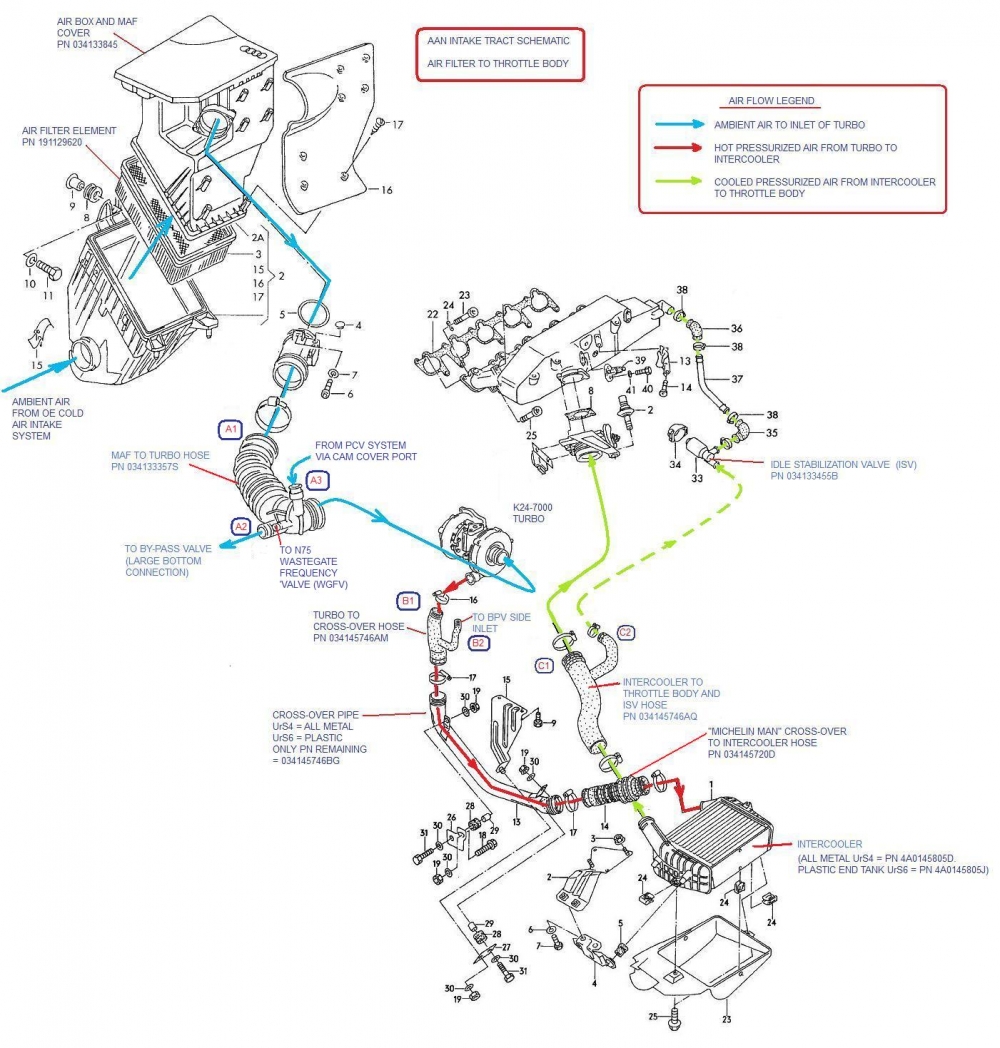
The G28 code is likely because you pulled the codes with the engine off. The other two together and your symptoms, to me, indicate that you have an air leak somewhere. Strongly suggest that you do a full boost leak test, pressurizing at the the turbo discharge hose if not the turbo intake hose and using a soapy water spray bottle and 1 Bar pressure (constant until you find the leak).
The additive fault is long present in the list, it's because I have a leaky vacuum brake servo. When brake pedal gets pressed, in a specific position it starts to hiss and let through itself excess air into the manifold. But it only happens in a very specific pedal position, and was never throwing a CEL. The fault is there for a year or so. A new servo will solve it.
The idle fault is completely new and started a few days ago. I have nothing to pressure test, as all the hoses are completely new. The clamps are new, I went over everything at least 10 times, while I was at the rebuild process. I built it so that I don't have to worry about stuff like inaccessible (or hardly accessible) hoses. And when I was at the PCV remake (2 days ago), I went over the hoses again.
I realigned the throttle position sensor again today. Got it to drop the idle to 880 rpm. Will see if it throws a fault code again. Still a bit too high though.
Did a MAF test while I was at it, just to be sure. The readings do not differ from those I made last summer.
I'm gonna get another ISV tomorrow, see if will help (if I get the CEL after the realignment).
Also, remembered that the issue starts only when engine is hot. No CEL's while cold.
These are the codes.
What could cause this? Dying ISV? Sticking throttle plate?
The G28 code is likely because you pulled the codes with the engine off. The other two together and your symptoms, to me, indicate that you have an air leak somewhere. Strongly suggest that you do a full boost leak test, pressurizing at the the turbo discharge hose if not the turbo intake hose and using a soapy water spray bottle and 1 Bar pressure (constant until you find the leak).
As a system, it functions well, now that I've played around it a little I understand the principles why it was made like that, but I'm surprised they didn't include somekind of a PCV filter element so that we could do just fine without catch cans, surely they knew that turbos feel better without oily fumes being thrown at them.
Next on the list - restoration of the rear suspension. I have a dissasembled rear sway bar assembly, which I'm gonna refurb with new bearings, abs sensors, poly bushes from Albert & control arms.
After that - 044.
If you searched the pcv here on this site.a lot of threads will show up
And alternative ways to eliminate the pcv.i have some oil surged out the pcv
too.i just have no time to handle this thing.with stock power level,the stock pcv
is doing fine but not with big turbo cars.the slosh effect will vomit the motor oil
out of the pcv.from my experience with high mileages car,if the valve guides are
worn out ,the excessive blow by will add on and making the situation even wosrse atleast
on my car.
Problems again... This thing doesn't want to let me sleep...
These are the codes.
Pay attention only to the idle speed regulation. The premise is following:
1. Driving normally, car runs good, no issues on boost or low load.
2. Idle seems fine, but a bit high (around 900-950).
3. Then, CEL pops up. Idle does not change. But the car feels limpy when I lightly touch the throttle to accelerate, after a second or two, it comes back to normal. Transition to and off throttle seems rough and the car is "jolting" during it.
4. CEL disappears after shutting the car off and starting it again, but pops up after some time.
This is my idle
What could cause this? Dying ISV? Sticking throttle plate?
The pcv systems on these cars are poor and do take some work as you have found.
Sent from my LG-H955 using Tapatalk
As a system, it functions well, now that I've played around it a little I understand the principles why it was made like that, but I'm surprised they didn't include somekind of a PCV filter element so that we could do just fine without catch cans, surely they knew that turbos feel better without oily fumes being thrown at them.
Next on the list - restoration of the rear suspension. I have a dissasembled rear sway bar assembly, which I'm gonna refurb with new bearings, abs sensors, poly bushes from Albert & control arms.
A write-up about my adventures with the PCV system.
So, the initial idea was to kill all valves and just run a straight line from the block breather through a catch can into the turbo intake boot. For that I cut off the bleeder valve pipe from the block distributor and welded it shut. The idea was working for a day, and then problems began. Car started to mysteriously leak oil through the oil filler cap and the oil dipstick. I thought that was because I was missing the oil deflector under the cam cover and the dipstick seal. Nope, that was because there was a pressure build up during idle and low loads. So the worst thing happened yesterday, when I gave the car a big punch. The vacuum from the turbo pulled up the oil into the can and I nearly lost all of my visible dipstick oil level amount.
I stopped and heard the lifters ticking, which is the first sign of insufficient oil level. Had some help and got oil, filled up and went home. Spent half of the night in the garage remaking the system.
So the baseline right now is the following (and it will probably stay that way):
1: Modified catch can. Total of 4 ports. Baffled.
2: Stock system, with new valves.
3. Stock system connected to the catch can before going off into the intake.
As seen from the picture, the ports are as follows:
Top of the can - goes to the transfer pipe and intake boot.
Farthest small port - bleeder valve pipe from the block distributor. The nipple has a copper tube inside which goes to the bottom of the can, forcing the fumes to go through the baffling.
Closest small port - goes to the bleeder valve & intake manifold.
Bottom of the can - comes from the pressure regulating valve.
I've been driving for the second day and the leaking places are now dry and dandy. Gonna leave the system as it is now. Ironic, wanted to get rid of valves and excess hoses, ended up having more of them than stock...
We process personal data about users of our site, through the use of cookies and other technologies, to deliver our services, personalize advertising, and to analyze site activity. We may share certain information about our users with our advertising and analytics partners. For additional details, refer to our Privacy Policy.
By clicking "I AGREE" below, you agree to our Privacy Policy and our personal data processing and cookie practices as described therein. You also acknowledge that this forum may be hosted outside your country and you consent to the collection, storage, and processing of your data in the country where this forum is hosted.




 good luck
Leave a comment: